
World War I and America examines the role the United States played in World War I and the impact of this move away from a policy of isolationism. Viewers will learn about life on the homefront and at war through documents, posters, and photos from the Gilder Lehrman Collection. Among the highlights are recruitment broadsides, a pro-war letter by Theodore Roosevelt, Woodrow Wilson’s 1917 message to Congress, letters, diary entries, photographs from the Western Front, and more.
World War I and America

Purchase: $1,875
Rent: $495
Logistical Information
Size: Six freestanding sections, requiring 18 running feet for display.
Purchase Information: Your institution may purchase a copy of this exhibition for permanent use for $1,875. This includes all panels, supplemental material, and carrying bags for each panel. A travel case is available as a separate purchase.
Rental Information: $495 for a four-week display period
More logistical information can be found in the World War I Exhibition Guide.
Panel One
World War I and America
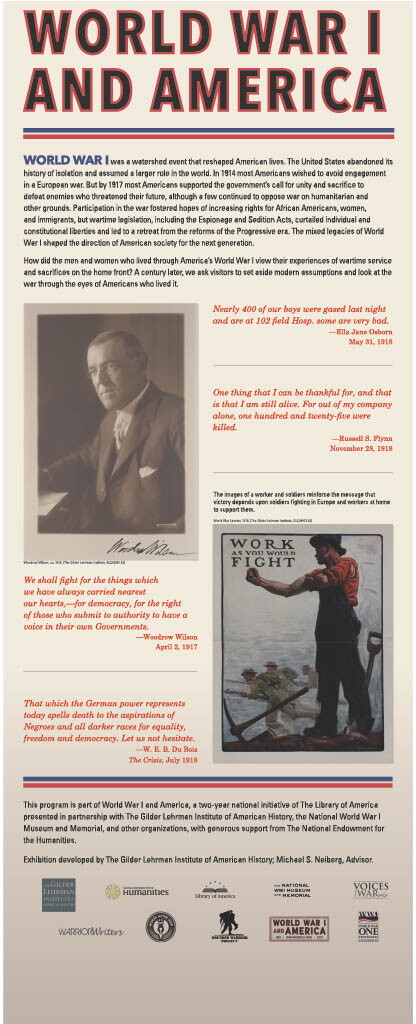
Panel Contents
- Quote from Ella Jane Osborn
- Quote from Russell S. Flynn
- World War I poster, 1918. (The Gilder Lehrman Institute, GLC09521.02)
- Woodrow Wilson, ca. 1915. (The Gilder Lehrman Institute, GLC02551.02)
- Quote from Woodrow Wilson
- Quote from W. E. B. Du Bois
Panel Two
The US: An Industrial Nation in the World
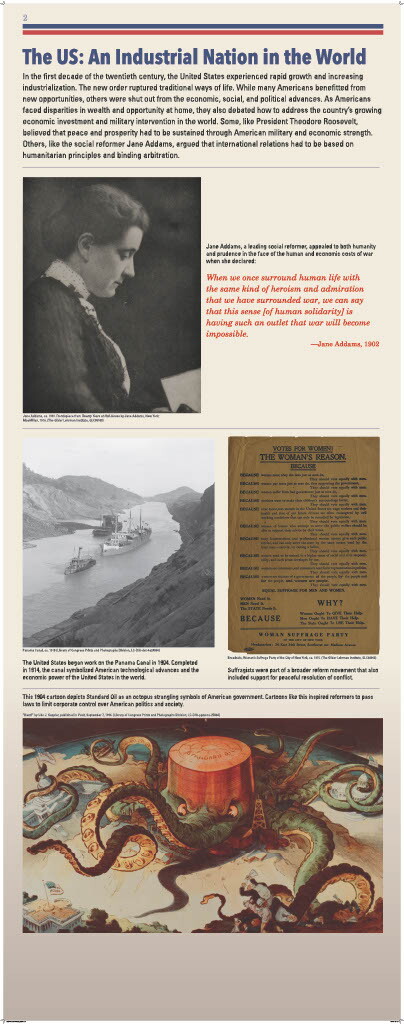
Panel Contents
- Quote from Jane Addams
- Jane Addams, ca. 1910. Frontispiece from Twenty Years at Hull-House by Jane Addams, New York, 1910. (The Gilder Lehrman Institute, GLC05168)
- Panama Canal, ca. 1915. (Library of Congress)
- Broadside, Woman’s Suffrage Party of the City of New York, ca. 1915. (The Gilder Lehrman Institute, GLC08963)
- Udo J. Keppler, “Next!,” Puck, September 7, 1904. (Library of Congress)
Panel Three
The Road to War
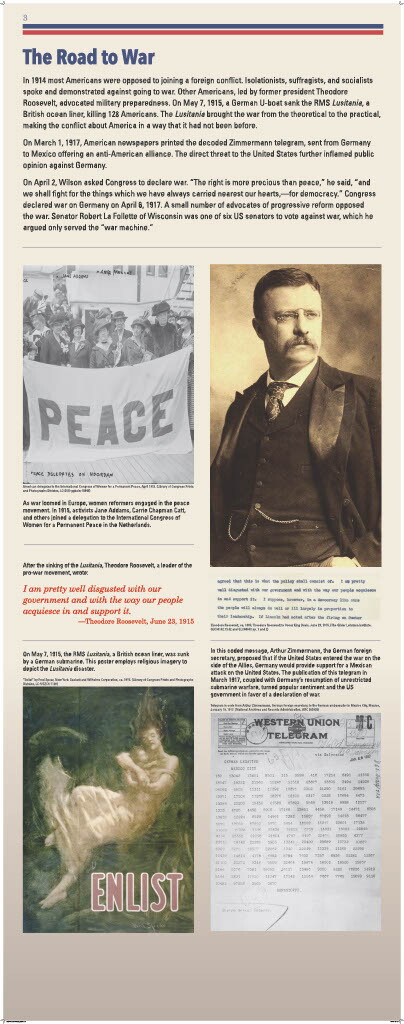
Panel Contents
- American delegates to the International Congress of Women for a Permanent Peace, April 1915. (Library of Congress)
- Theodore Roosevelt, ca. 1905. (The Gilder Lehrman Institute, GLC00162.13.02)
- Theodore Roosevelt to Oscar King Davis, June 23, 1915. (The Gilder Lehrman Institute, GLC08003 pp. 1 and 2)
- Quote from Theodore Roosevelt
- “Enlist” by Fred Spear, New York, ca. 1915. (Library of Congress)
- Telegram in code from Arthur Zimmermann, German foreign secretary, to the German ambassador in Mexico City, Mexico, January 19, 1917. (National Archives)
Panel Four
The Experience of War: Why We Fight
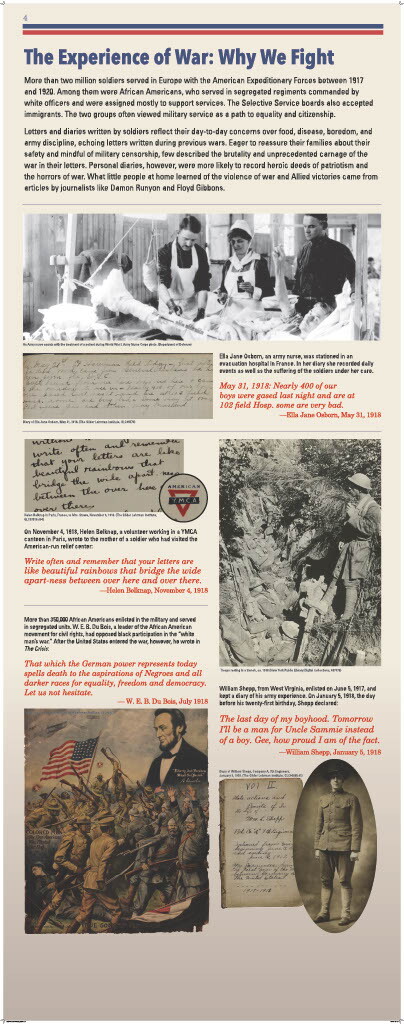
Panel Contents
- An Army nurse assists with the treatment of a patient during World War I. Army Nurse Corps photo. (Department of Defense)
- Diary of Ella Jane Osborn, May 31, 1918. (The Gilder Lehrman Institute, GLC06570)
- Quote from Ella Jane Osborn
- Helen Belknap in Paris, France, to Mrs. Stowe, November 6, 1918. (The Gilder Lehrman Institute, GLC07810.004)
- Quote from Helen Belknap
- Quote from W. E. B. Du Bois
- Troops resting in a trench, ca. 1918. (New York Public Library Digital Collections)
- World War I poster, 1918. (The Gilder Lehrman Institute, GLC09121)
- Diary of William Shepp, Company A, 7th Engineers, January 5, 1918. (The Gilder Lehrman Institute, GLC06888.01)
- Quote from William Shepp
Panel Five
The Home Front: Selling Unity, Suppressing Dissent
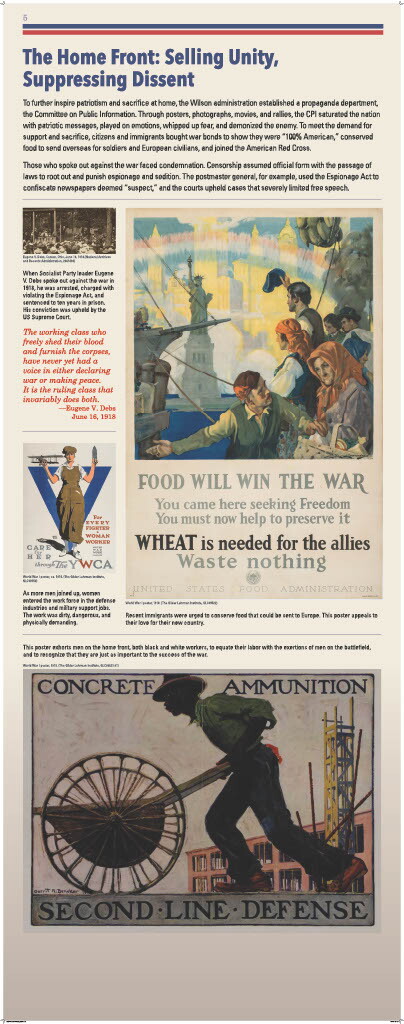
Panel Contents
- Eugene V. Debs, Canton, Ohio, June 16, 1918. (National Archives)
- Quote from Eugene V. Debs
- World War I poster, ca. 1918. (The Gilder Lehrman Institute, GLC09550)
- World War I poster, 1918. (The Gilder Lehrman Institute, GLC09522)
- World War I poster, 1918. (The Gilder Lehrman Institute, GLC09521.01)
Panel Six
Coming Home
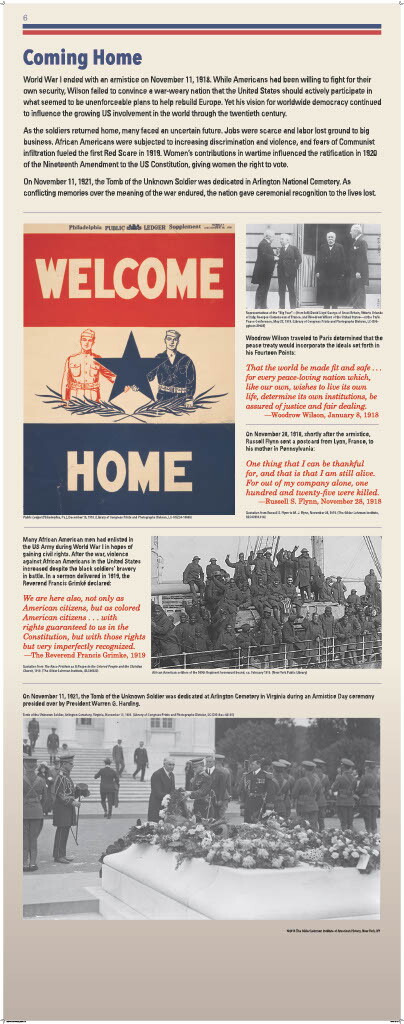
Panel Contents
- Representatives of the “Big Four”—(from left) David Lloyd George of Great Britain, Vittorio Orlando of Italy, Georges Clemenceau of France, and Woodrow Wilson of the United States—at the Paris Peace Conference, May 27, 1919. (Library of Congress)
- Quote from Woodrow Wilson
- Public Ledger (Philadelphia, Pa.), December 15, 1918. (Library of Congress)
- Quote from Russell S. Flynn to M. J. Flynn, November 28, 1918. (The Gilder Lehrman Institute, GLC07810.014)
- Quote from Reverend Francis Grimke, The Race Problem as It Respects the Colored People and the Christian Church, 1919. (The Gilder Lehrman Institute, GLC06122)
- African American soldiers of the 369th Regiment homeward bound, ca. February 1919. (New York Public Library)
- Tomb of the Unknown Soldier, Arlington Cemetery, Virginia, November 11, 1921. (Library of Congress Prints and Photographs Division, LC-DIG-hec-43115)
Frequently Asked Questions
If you need more information, please fill out this traveling exhibitions inquiry form. We strive to respond to inquiries within one business day.
Setup Guide
General Questions
Do I need to pay sales tax?
State sales tax laws vary. You may be liable for sales taxes. The Gilder Lehrman Institute will contact you about your potential sales tax obligations.
How can I pay?
We accept credit cards, checks, and purchase orders, but we do not currently accept bank transfers.
Do you offer any discounts or grants?
Unfortunately, we are unable to offer any discounts or grants at this time. We recommend DonorsChoose for schools that need financial assistance to rent or purchase an exhibition.
How do you ship the exhibitions?
Exhibitions are shipped in wheeled cases measuring 15 x 15 x 40 inches and weighing approximately 90 pounds. FedEx handles all shipping. Once your exhibition has shipped, you will receive a tracking number.
How do I set up the exhibition?
We include detailed setup instructions with each rental. Please note that different exhibitions have slightly different setup instructions, so make sure you refer to the correct type of exhibition.
What happens if something breaks after I receive my exhibition?
We are always here to help you troubleshoot or order new parts. The venue will bear the costs of replacement parts due to venue error or excessive wear and tear.
Purchase
What materials are included in my exhibition purchase?
With your purchase, we will order a brand-new exhibition to send to you. Each panel comes in its own zipped sleeve for storage and transport. You will also receive all the supplementary materials typically included with a rental, including the Exhibition Guide and setup instructions.
Does my purchased exhibition come with the travel/storage case?
The travel/storage case is a separate purchase. You can add a case for your exhibition for an additional $500 on the same menu where you bought the exhibition. All exhibitions can fit into one case, except for Freedom: A History of the US, which requires two.
Is shipping included in the purchase price?
Yes!
Can I purchase a “used” exhibition instead of a new one for a lower price?
Occasionally, a limited number of gently used exhibitions are available for purchase at a discounted price. For the current selection of gently used exhibitions, visit the shop. Exhibitions are available on a first-come, first-served basis and are sold as-is.
How long will it take to receive my exhibition?
Once we receive payment, please allow 2 weeks to print and ship your new exhibition. Exhibition orders are not sent for printing until we receive payment in full.
Rental
How long is the rental period?
4 weeks. Please let us know if you would like a longer booking period, and we will do our best to accommodate you! However, we cannot offer discounts for shortened booking periods.
How far in advance should I book my rental?
It is recommended to book 2–3 months in advance of your desired rental date, but we can accept bookings up to a year in advance. Please note that we do not ship exhibitions until payment is received in full, so please keep this in mind when booking your exhibition.
What is included in my rental fee?
The rental cost is a flat fee that covers shipping, the exhibition, and supplemental materials. Extra charges will only occur if a venue damages an exhibition.
Can I bring the exhibition to multiple venues during my rental period?
Exhibitions are limited to the location booked in the contract. While you’re free to relocate the exhibition to different buildings or rooms within your contracted location, we do not permit any other circulation of the exhibition. If you need to feature an exhibition at various locations, we recommend purchasing it rather than renting it.
Can I reschedule my rental?
If your new rental dates are available, we will happily reschedule your rental, provided the exhibition has not already shipped to you.
How do I ship the exhibition back to you?
We’ll send you a FedEx label up to 10 days before the end of your display period and set up a pickup appointment for your exhibition return. Please remove any existing labels from the case before attaching the new one, and notify our team if there are any special instructions for FedEx.