This exhibition examines voting rights, emphasizing the role of the US Constitution and the interplay between the states and federal government in determining who is allowed to vote. Beginning with the founding era and going up to the election of 2000, this exhibition explores the complex history of the right to vote that forms the core of our nation’s democracy. Topics include voting as a constitutional right, women’s suffrage, Reconstruction and Jim Crow era voting rights, the Civil Rights Movement, and the enfranchisement of Indigenous peoples.
Who Can Vote?

Purchase: $1,950
Rent: $495
Logistical Information
Size: Seven freestanding retractable panels, each 33" x 81", requiring 21 running feet for display.
Purchase Information: Your institution may purchase a copy of this exhibition for permanent use for $1,950. This includes all panels, supplemental material, and carrying bags for each panel. A travel case is available as a separate purchase.
Rental Information: $495 for a four-week display period
More logistical information can be found in the Who Can Vote? Exhibition Guide.
Panel One
The Founding Era, 1787–1838
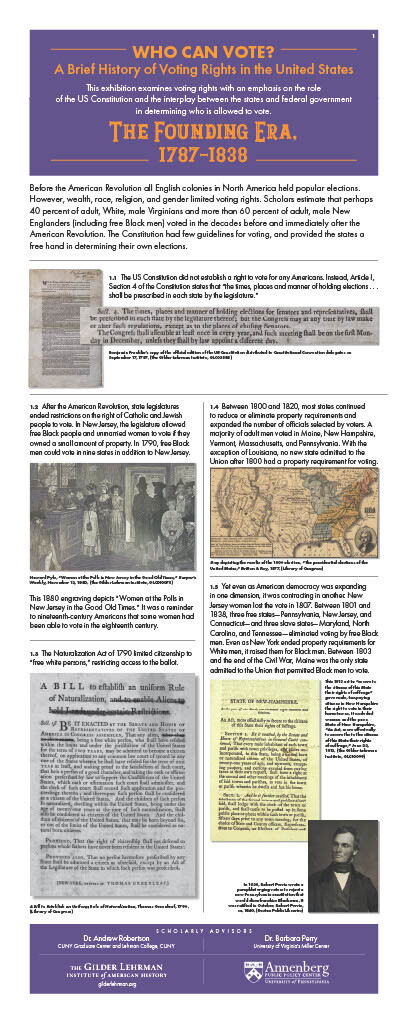
Panel Contents
- Benjamin Franklin’s copy of the official edition of the US Constitution, distributed to Constitutional Convention delegates on September 17, 1787. (The Gilder Lehrman Institute, GLC03585)
- Howard Pyle, “Women at the Polls in New Jersey in the Good Old Times,” Harper’s Weekly, November 13, 1880. (The Gilder Lehrman Institute, GLC10078)
- A Bill to Establish a Uniform Rule of Naturalization, Thomas Greenleaf, 1790. (Library of Congress)
- Map depicting the results of the 1800 election. “The Presidential Elections of the United States,” Britton & Rey, 1877. (Library of Congress)
- “An Act, more effectually to secure the citizens of this State their rights of suffrage,” June 23, 1813. (The Gilder Lehrman Institute, GLC10099)
- In 1838, Robert Purvis wrote a pamphlet urging voters to reject a new Pennsylvania constitution that would disenfranchise Black men. It was ratified in October. Robert Purvis, ca. 1840. (Boston Public Libraries)
Panel Two
The Jacksonian Era to the Civil War, 1828–1865
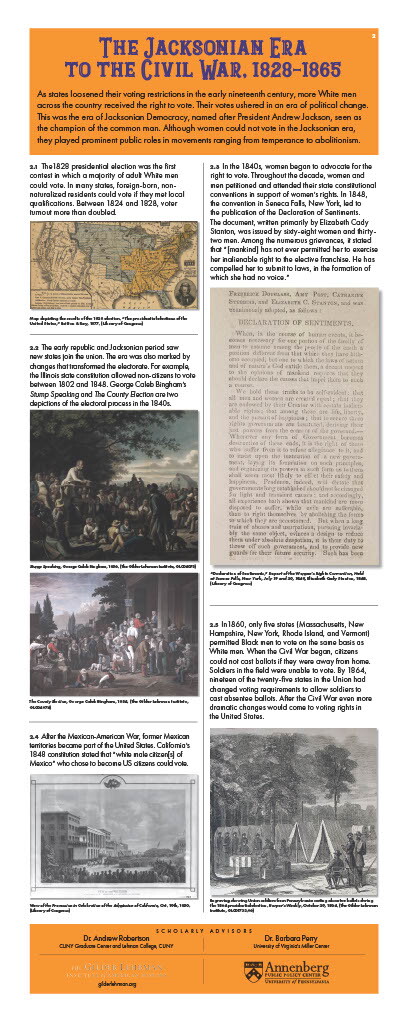
Panel Contents
- Map depicting the results of the 1828 election. “The Presidential elections of the United States,” Britton & Rey, 1877. (Library of Congress)
- Stump Speaking, George Caleb Bingham, 1856. (The Gilder Lehrman Institute, GLC04075)
- The County Election, George Caleb Bingham, 1854. (The Gilder Lehrman Institute, GLC04074)
- “Declaration of Sentiments,” Report of the Woman’s Rights Convention, Held at Seneca Falls, New York, July 19 and 20, 1848, Elizabeth Cady Stanton, 1848. (Library of Congress)
- View of the Procession in Celebration of the Admission of California, Oct. 19th, 1850. (Library of Congress)
- Engraving showing Union soldiers from Pennsylvania casting absentee ballots during the 1864 presidential election. Harper’s Weekly, October 29, 1864. (The Gilder Lehrman Institute, GLC01733.06)
Panel Three
The Civil War and Reconstruction, 1865–1877
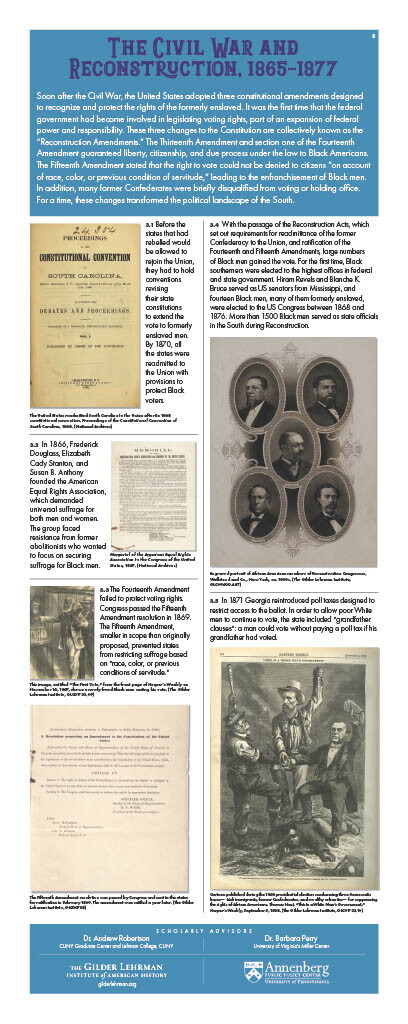
Panel Contents
- Proceedings of the Constitutional Convention of South Carolina, 1868. (National Archives)
- Memorial of American Equal Rights Association to the Congress of the United States, 1867. (National Archives)
- “The First Vote,” from the front page of Harper’s Weekly on November 16, 1867, shows a newly freed Black man casting his vote. (The Gilder Lehrman Institute, GLC01733.09)
- The Fifteenth Amendment resolution, 1869. (The Gilder Lehrman Institute, GLC00788)
- Engraved portrait of African American members of Reconstruction Congresses, Wellstood and Co., New York, ca. 1880s. (The Gilder Lehrman Institute, GLC09400.447)
- Thomas Nast, “This Is a White Man’s Government,” Harper’s Weekly, September 5, 1868. (The Gilder Lehrman Institute, GLC01733.10)
Panel Four
Voting in the Jim Crow Era
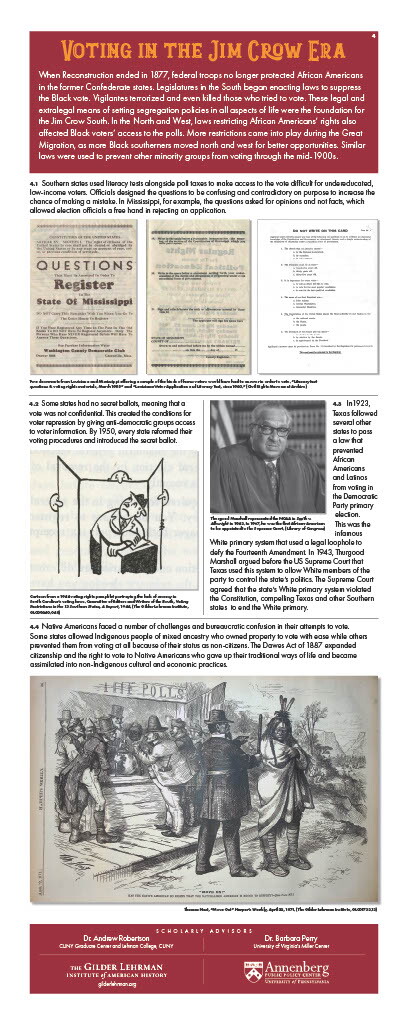
Panel Contents
- Two documents from Louisiana and Mississippi offering a sample of the kinds of forms voters would have had to answer in order to vote. “Literacy test questions & voting rights materials, March 1955” and “Louisiana Voter Application and Literacy Test, circa 1963.” (Civil Rights Movement Archive)
- Cartoon from a 1944 voting rights pamphlet portraying the lack of secrecy in South Carolina’s voting laws. Committee of Editors and Writers of the South, Voting Restrictions in the 13 Southern States, A Report, 1944. (The Gilder Lehrman Institute, GLC09640.048)
- Thurgood Marshall represented the NCAA in Smith v. Allwright in 1943. In 1967, he was the first African American to be appointed to the Supreme Court. (Library of Congress)
- Thomas Nast, “Move on!” Harper’s Weekly, April 22, 1871. (The Gilder Lehrman Institute, GLC01733.13)
Panel Five
Women’s Suffrage
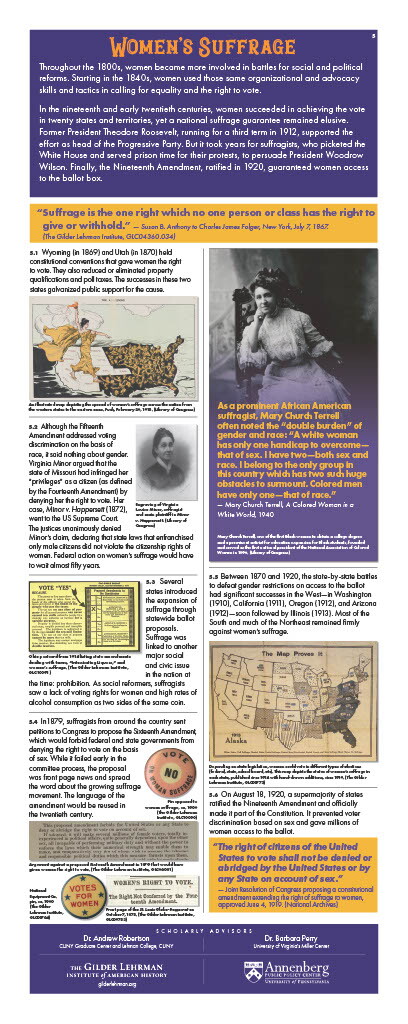
Panel Contents
- An illustrated map depicting the spread of women’s suffrage across the nation from the western states to the eastern ones. Puck, February 20, 1915. (Library of Congress)
- Engraving of Virginia Louisa Minor, suffragist and main plaintiff in Minor v. Happersett. (Library of Congress)
- Ohio postcard from 1914 listing state amendments dealing with taxes, “Intoxicating Liquors,” and women’s suffrage. (The Gilder Lehrman Institute, GLC10091)
- Pin opposed to women's suffrage, ca. 1900. (The Gilder Lehrman Institute, GLC10090)
- Argument against a proposed Sixteenth Amendment in 1879 that would have given women the right to vote. (The Gilder Lehrman Institute, GLC06081)
- National Equipment Co. pin, ca. 1900. (The Gilder Lehrman Institute, GLC09764)
- Front page of the St. Louis Globe-Democrat on October 7, 1875. (The Gilder Lehrman Institute, GLC09753)
- This map depicts the status of women’s suffrage in each state, published circa 1914 with hand-drawn additions, circa 1919. (The Gilder Lehrman Institute, GLC09773)
- Quote from the Joint Resolution of Congress proposing a constitutional amendment extending the right of suffrage to women, approved June 4, 1919. (National Archives)
Panel Six
The Civil Rights Era
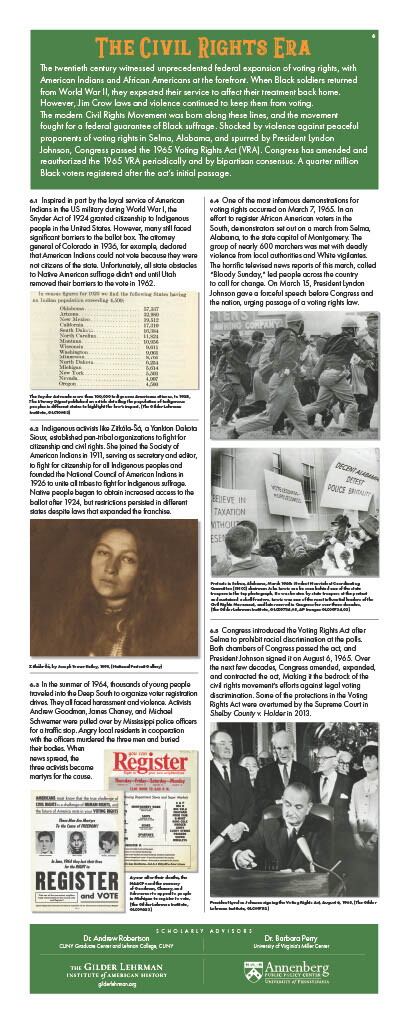
Panel Contents
- The Literary Digest article detailing the population of Indigenous peoples in different states to highlight the law’s impact. (The Gilder Lehrman Institute, GLC10083)
- Zitkála-Šá, by Joseph Turner Keiley, 1898. (National Portrait Gallery)
- A year after their deaths, the NAACP used the memory of Goodman, Chaney, and Schwerner to appeal to people in Michigan to register to vote. (The Gilder Lehrman Institute, GLC09623)
- Protests in Selma, Alabama, March 1965: Student Nonviolent Coordinating Committee (SNCC) chairman John Lewis can be seen behind one of the state troopers in the top photograph. (The Gilder Lehrman Institute, GLC09734.05, GLC09734.03)
- President Lyndon Johnson signing the Voting Rights Act, August 6, 1965. (The Gilder Lehrman Institute, GLC09752)
Panel Seven
Enfranchising New Voters
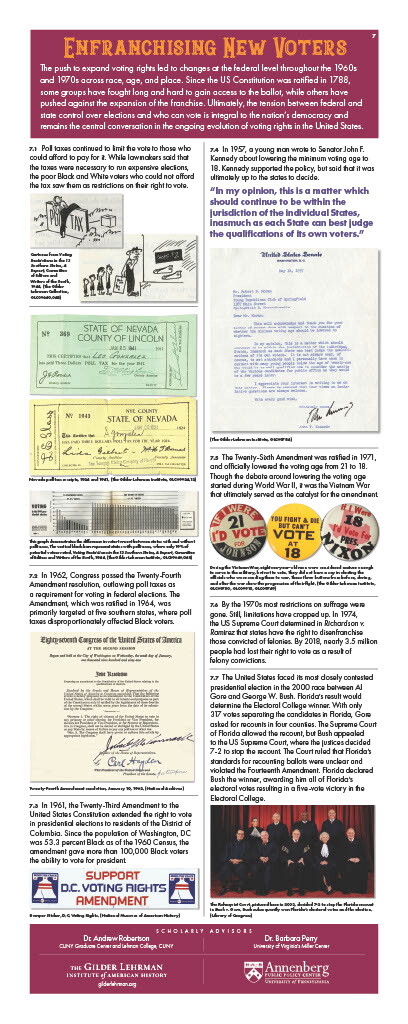
Panel Contents
- Cartoons from Voting Restrictions in the 13 Southern States, A Report, Committee of Editors and Writers of the South, 1944. (The Gilder Lehrman Institute, GLC09640.048)
- Nevada poll tax receipts, 1924 and 1941. (The Gilder Lehrman Institute GLC09924.12) 10
- Voting Restrictions in the 13 Southern States, A Report, Committee of Editors and Writers of the South, 1944. (The Gilder Lehrman Institute, GLC09640.048)
- Twenty-Fourth Amendment resolution, January 10, 1962. (National Archives)
- Bumper Sticker, D.C. Voting Rights. (National Museum of American History)
- John F. Kennedy to Robert D. Moran, letter. 1957. (The Gilder Lehrman Institute, GLC09784)
- Quote from John F. Kennedy
- These three buttons from before, during, and after the war show the progression of their fight. (The Gilder Lehrman Institute, GLC09750, GLC09915, GLC09749)
- The Rehnquist Court, pictured here in 2003, decided 7-2 to stop the Florida recount in Bush v. Gore. Bush subsequently won Florida’s electoral votes and the election. (Library of Congress)
Exhibition Resources
Classroom resources are available in the Who Can Vote Educator's Guide and as part of the Right to Vote Project.
Frequently Asked Questions
If you need more information, please fill out this traveling exhibitions inquiry form. We strive to respond to inquiries within one business day.
Setup Guide
General Questions
Do I need to pay sales tax?
State sales tax laws vary. You may be liable for sales taxes. The Gilder Lehrman Institute will contact you about your potential sales tax obligations.
How can I pay?
We accept credit cards, checks, and purchase orders, but we do not currently accept bank transfers.
Do you offer any discounts or grants?
Unfortunately, we are unable to offer any discounts or grants at this time. We recommend DonorsChoose for schools that need financial assistance to rent or purchase an exhibition.
How do you ship the exhibitions?
Exhibitions are shipped in wheeled cases measuring 15 x 15 x 40 inches and weighing approximately 90 pounds. FedEx handles all shipping. Once your exhibition has shipped, you will receive a tracking number.
How do I set up the exhibition?
We include detailed setup instructions with each rental. Please note that different exhibitions have slightly different setup instructions, so make sure you refer to the correct type of exhibition.
What happens if something breaks after I receive my exhibition?
We are always here to help you troubleshoot or order new parts. The venue will bear the costs of replacement parts due to venue error or excessive wear and tear.
Purchase
What materials are included in my exhibition purchase?
With your purchase, we will order a brand-new exhibition to send to you. Each panel comes in its own zipped sleeve for storage and transport. You will also receive all the supplementary materials typically included with a rental, including the Exhibition Guide and setup instructions.
Does my purchased exhibition come with the travel/storage case?
The travel/storage case is a separate purchase. You can add a case for your exhibition for an additional $500 on the same menu where you bought the exhibition. All exhibitions can fit into one case, except for Freedom: A History of the US, which requires two.
Is shipping included in the purchase price?
Yes!
Can I purchase a “used” exhibition instead of a new one for a lower price?
Occasionally, a limited number of gently used exhibitions are available for purchase at a discounted price. For the current selection of gently used exhibitions, visit the shop. Exhibitions are available on a first-come, first-served basis and are sold as-is.
How long will it take to receive my exhibition?
Once we receive payment, please allow 2 weeks to print and ship your new exhibition. Exhibition orders are not sent for printing until we receive payment in full.
Rental
How long is the rental period?
4 weeks. Please let us know if you would like a longer booking period, and we will do our best to accommodate you! However, we cannot offer discounts for shortened booking periods.
How far in advance should I book my rental?
It is recommended to book 2–3 months in advance of your desired rental date, but we can accept bookings up to a year in advance. Please note that we do not ship exhibitions until payment is received in full, so please keep this in mind when booking your exhibition.
What is included in my rental fee?
The rental cost is a flat fee that covers shipping, the exhibition, and supplemental materials. Extra charges will only occur if a venue damages an exhibition.
Can I bring the exhibition to multiple venues during my rental period?
Exhibitions are limited to the location booked in the contract. While you’re free to relocate the exhibition to different buildings or rooms within your contracted location, we do not permit any other circulation of the exhibition. If you need to feature an exhibition at various locations, we recommend purchasing it rather than renting it.
Can I reschedule my rental?
If your new rental dates are available, we will happily reschedule your rental, provided the exhibition has not already shipped to you.
How do I ship the exhibition back to you?
We’ll send you a FedEx label up to 10 days before the end of your display period and set up a pickup appointment for your exhibition return. Please remove any existing labels from the case before attaching the new one, and notify our team if there are any special instructions for FedEx.