
Becoming the United States is designed to introduce upper elementary–aged students to the beginnings of American history and the skills involved in primary source analysis. Using items from the Gilder Lehrman Collection, it explores individuals, groups, and documents that have contributed to who we are as a country and encourages students to think critically about the firsthand accounts of this era.
Becoming the US

Purchase: $1,950
Rent: $495
Logistical Information
Size: Seven freestanding retractable panels, each 33" x 81", requiring 21 running feet for display.
Purchase Information: Your institution may purchase a copy of this exhibition for permanent use for $1,950. This includes all panels, supplemental material, and carrying bags for each panel. A travel case is available as a separate purchase.
Rental Information: $495 for a four-week display period
More logistical information can be found in the Becoming the US Exhibition Guide.
Panel One
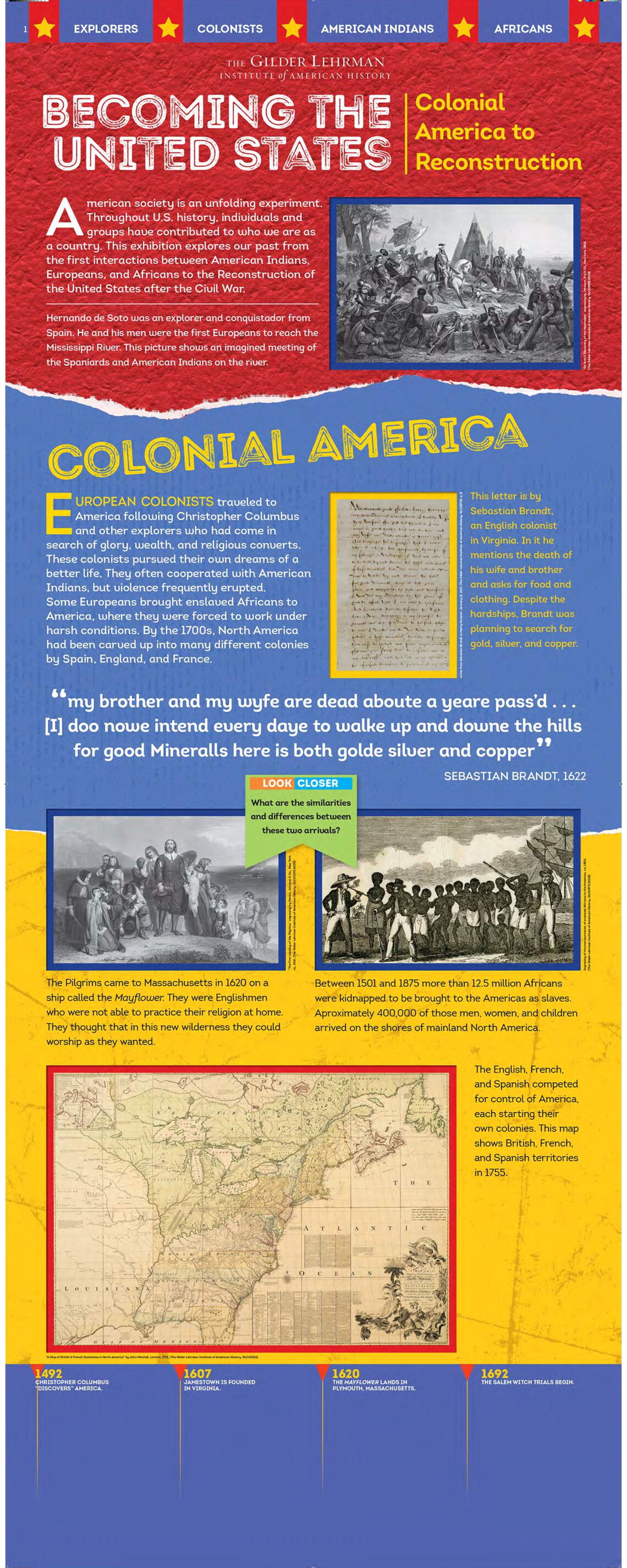
Becoming the United States: Colonial America to Reconstruction
Panel Content
- Letter from Sebastian Brandt to Henry Hovener, January 13, 1622. (The Gilder Lehrman Institute of American History, GLC00708)
- Quote from Sebastian Brandt to Henry Hovener
- “The First Landing of the Pilgrims,” engraving by Martin, Johnson & Co., New York, ca. 1856. (The Gilder Lehrman Institute of American History, GLC08878.0005)
- Engraving of the transportation of enslaved Africans to the Americas, ca. 1800. (The Gilder Lehrman Institute of American History, GLI09791.0034)
- “A Map of British and French Dominions in North America,” by John Mitchell, London, 1755. (The Gilder Lehrman Institute of American History, GLC03556)
Panel Two
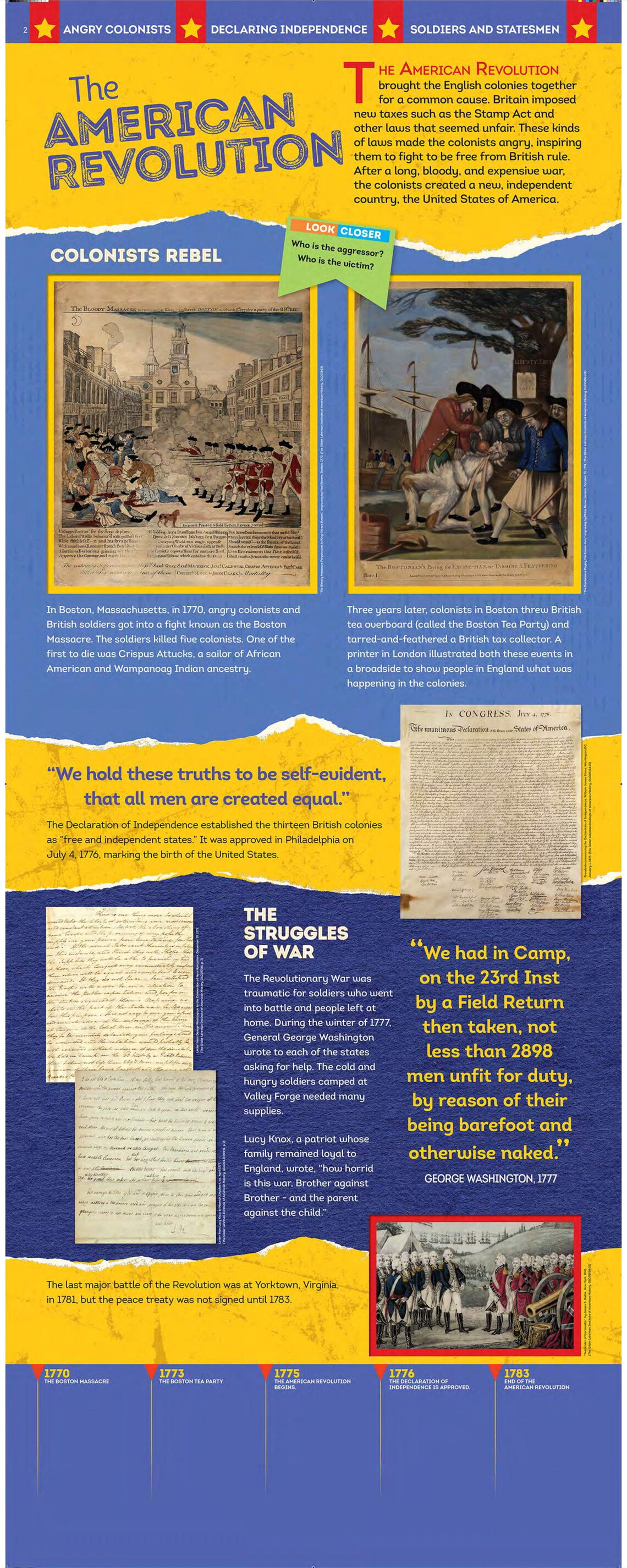
The American Revolution
Panel Content
- “The Bloody Massacre Perpetrated in King-Street Boston,” engraving by Paul Revere, Boston, 1770. (The Gilder Lehrman Institute of American History, GLC01868)
- “The Bostonian’s Paying the Excise-Man,” engraving by Philip Dawe, London, October 31, 1774. (The Gilder Lehrman Institute of American History, GLC04961.01)
- The Declaration of Independence, 1776. William James Stone, Washington, DC, January 1, 1823. (The Gilder Lehrman Institute of American History, GLC00154.02)
- Quote from the Declaration of Independence
- Letter from George Washington to the Convention of New Hampshire, December 29, 1777. (The Gilder Lehrman Institute of American History, GLC03706, p. 3)
- Quote from George Washington to the Convention of New Hampshire
- Letter from Lucy Knox to Hannah Urquhart, ca. April 1777. (The Gilder Lehrman Institute of American History, GLC02437.03405)
- “Surrender of Cornwallis,” by James S. Baillie, New York, 1845. (The Gilder Lehrman Institute of American History, GLC02918.02)
Panel Three
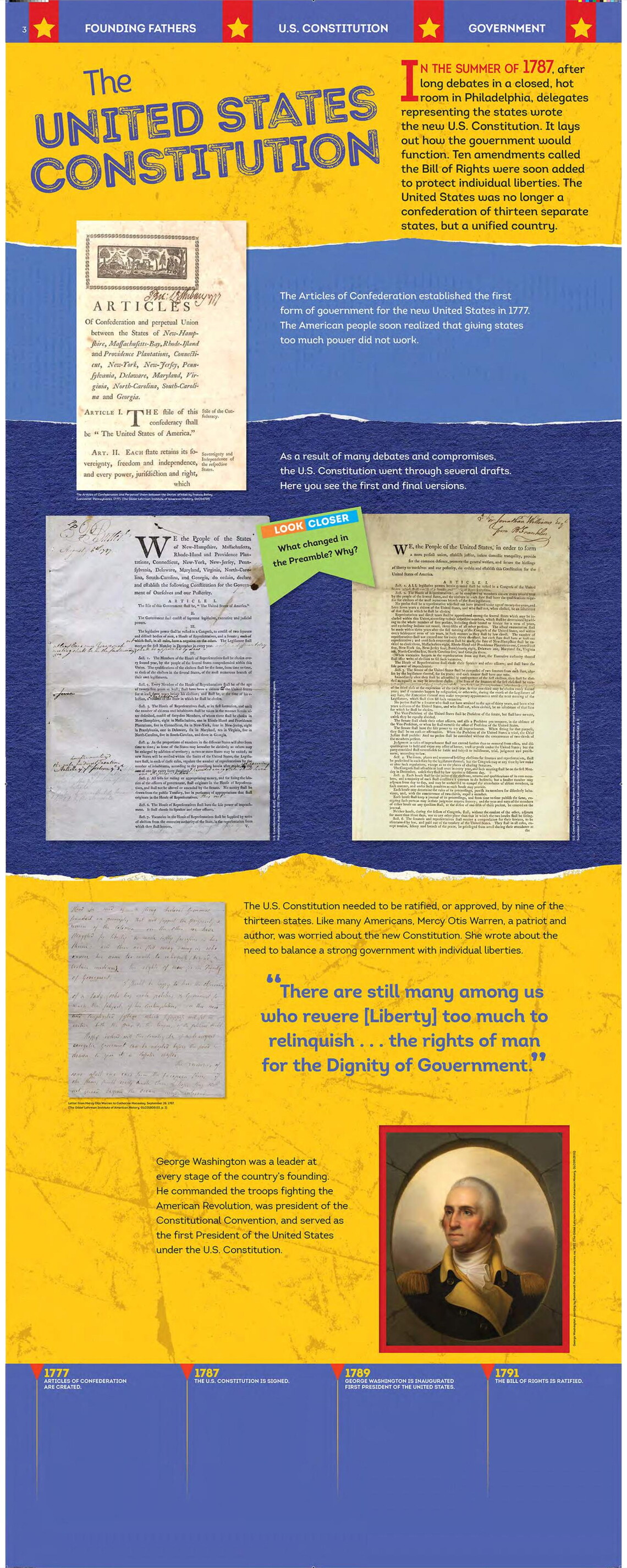
The United States Constitution
Panel Content
- The Articles of Confederation and Perpetual Union between the States, printed by Francis Bailey, Lancaster, Pennsylvania, 1777. (The Gilder Lehrman Institute of American History, GLC04759)
- U.S. Constitution [first draft] with notes by South Carolina delegate Pierce Butler, printed by Dunlap & Claypoole, August 6, 1787. (The Gilder Lehrman Institute of American History, GLC00819.01, p. 1)
- U.S. Constitution signed by Benjamin Franklin for his nephew Jonathan Williams, printed by Dunlap & Claypoole, September 17, 1787. (The Gilder Lehrman Institute of American History, GLC03585)
- Letter from Mercy Otis Warren to Catharine Macaulay, September 28, 1787. (The Gilder Lehrman Institute of American History, GLC01800.03, p. 2)
- Quote from Mercy Otis Warren to Catharine Macaulay
- George Washington, painting by Rembrandt Peale, oil on canvas, ca. 1852. (The Gilder Lehrman Institute of American History, ex-GLC09119.01)
Panel Four
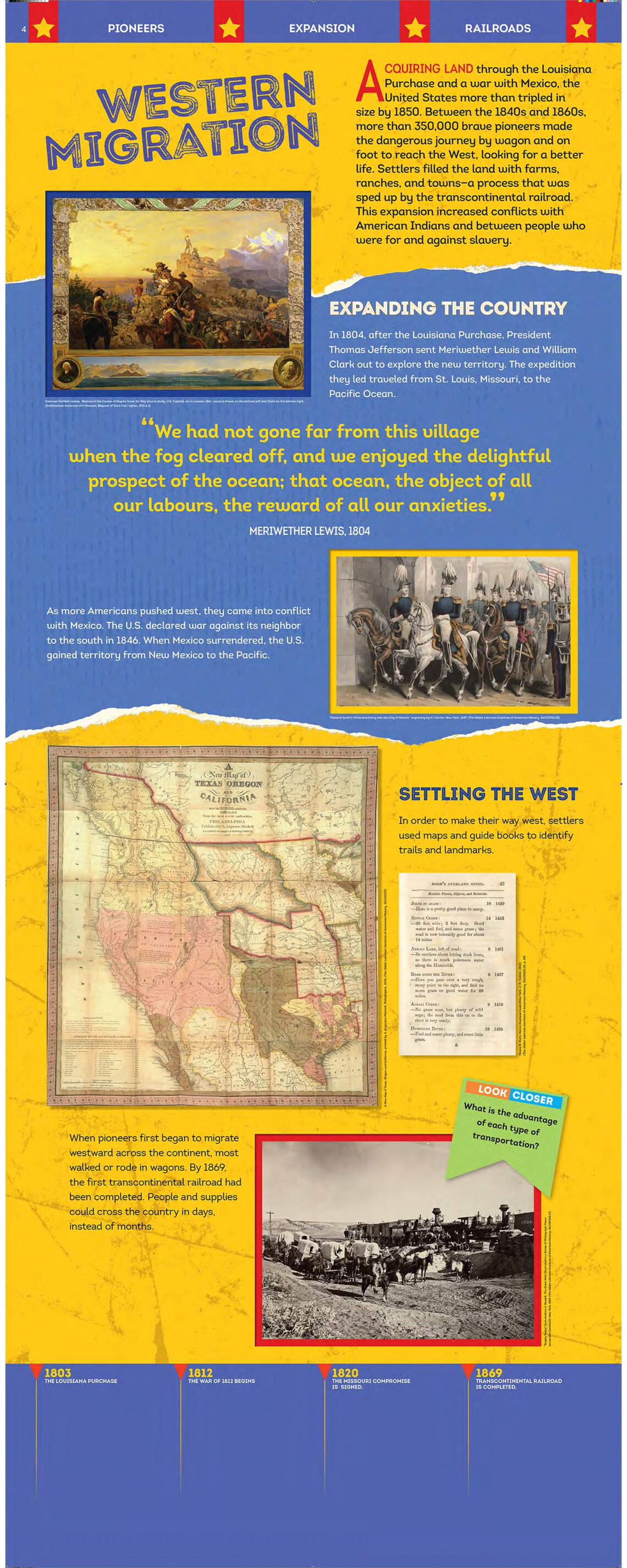
Western Migration
Panel Content
- Emanuel Gottlieb Leutze, Westward the Course of Empire Takes Its Way (mural study U.S. Capitol), oil on canvas, 1862. (Smithsonian American Art Museum, Bequest of Sara Carr Upton, 1931.5.1)
- Lewis Meriwether, History of the Expedition Under the Command of Captains Lewis and Clark, to the Sources of the Missouri, Philadelphia, 1814. (The Gilder Lehrman Institute of American History, GLC04051.01)
- Quote from Lewis Meriwether
- “General Scott’s Victorious Entry into the City of Mexico.” engraving by N. Currier, New York, 1847. (The Gilder Lehrman Institute of American History, GLC02918.01)
- A New Map of Texas, Oregon and California, printed by S. Augustus Mitchell, Philadelphia, 1846. (The Gilder Lehrman Institute of American History, GLC02130)
- Hosea B. Horn, Horn’s Overland Guide, New York, 1852. (The Gilder Lehrman Institute of American History, GLC04152.01, p. 49)
- Andrew J. Russell, “Supply Trains,” in The Great West Illustrated in a Series of Photograph Views Across the Continent, New York, 1869. (The Gilder Lehrman Institute of American History, GLC04348.27)
Panel Five
American Indians in a Changing World
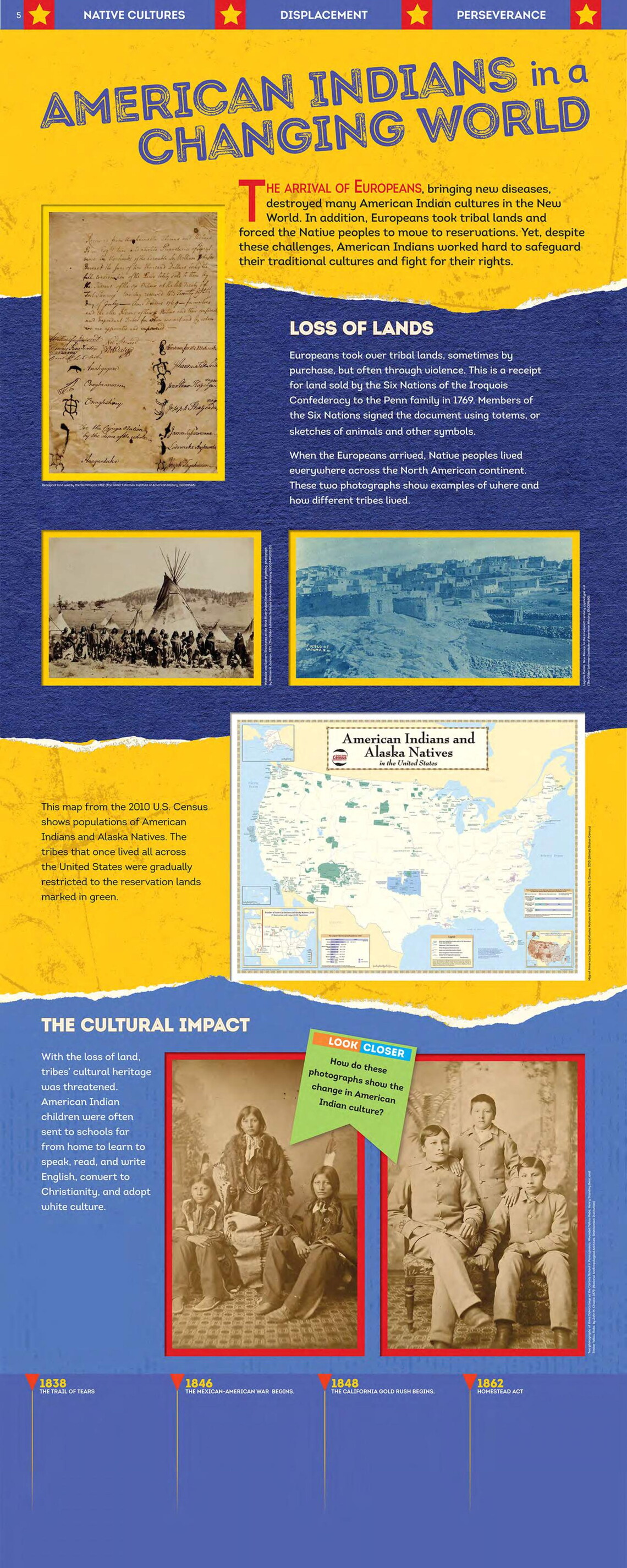
Panel Content
- Receipt of land sale by the Six Nations, 1769. (The Gilder Lehrman Institute of American History, GLC02548)
- Washakie and Eastern Shoshones at the Wind River Indian Reservation in Wyoming, photograph by William H. Jackson, 1871. (The Gilder Lehrman Institute of American History, GLC04490.00125)
- Laguna Pueblo, New Mexico, in the nineteenth century, cyanotype, n.d. (The Gilder Lehrman Institute of American History, GLC09860)
- Map of American Indians and Alaska Natives in the United States, U.S. Census, 2010. (United States Census)
- Two photographs of three Dakota boys at the Carlisle School in Pennsylvania, Wounded Yellow Robe, Henry Standing Bear, and Timber Yellow Robe, by John N. Choate, 1879. (National Anthropological Archives, Smithsonian Institution)
Panel Six
The Civil War
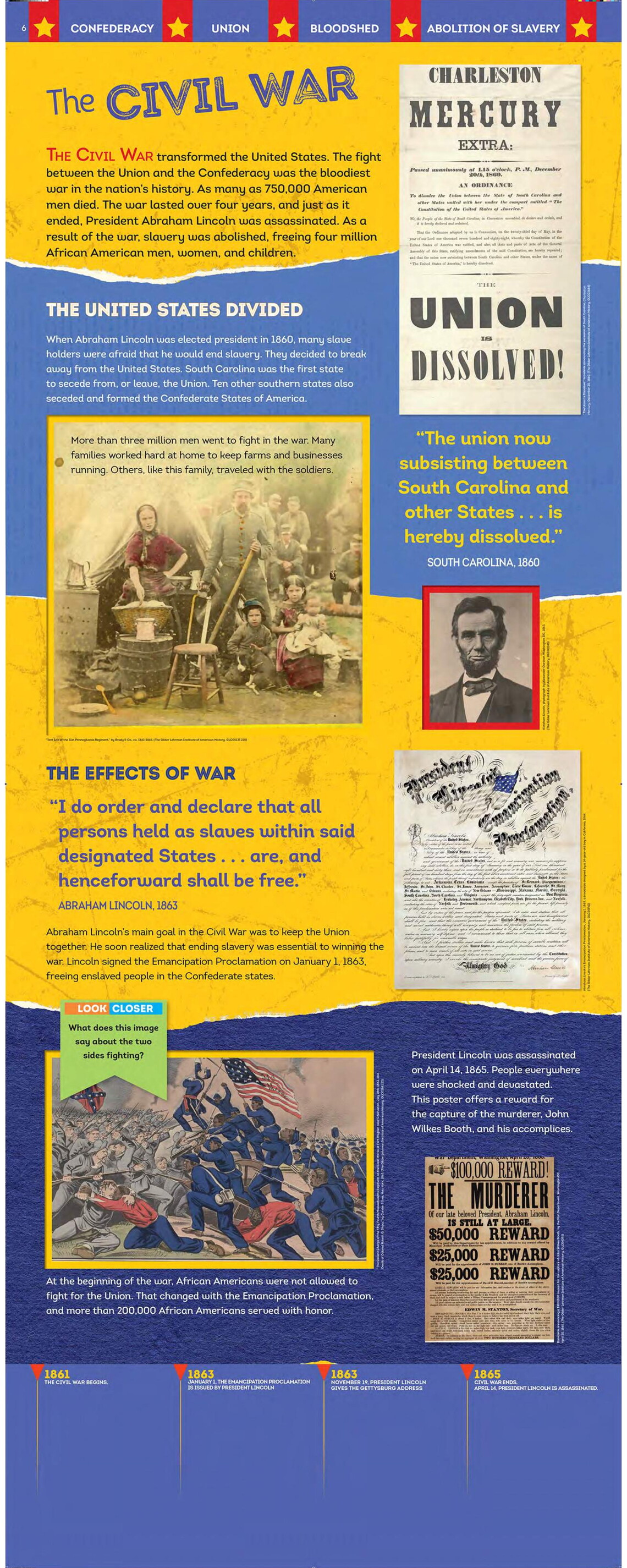
Panel Content
- “The Union Is Dissolved” broadside announcing the secession of South Carolina, 1860. (The Gilder Lehrman Institute of American History, GLC02688)
- Quote from “The Union Is Dissolved” broadside
- “Tent Life of the 31st Pennsylvania Regiment,” by Brody & Co., ca. 1861–1865. (The Gilder Lehrman Institute of American History, GLC05137.220)
- Abraham Lincoln, photograph by Alexander Gardner, Washington DC, 1863. (The Gilder Lehrman Institute of American History, GLC00245)
- “I do order and declare that all persons held as slaves within said designated States . . . are, and henceforward shall be free.” –Abraham Lincoln, 1863
- Abraham Lincoln’s Emancipation Proclamation, January 1, 1863, a broadside designed by a 14-year-old boy in California, 1864. (The Gilder Lehrman Institute of American History, GLC00742)
- “The Gallant Charge of the Fifty Fourth Massachusetts Regiment on the Rebel Walls of Fort Wagner near Charleston, July 18th, 1863, and Death of Colonel Robert G. Shaw,” by Currier & Ives, New York, 1863. (The Gilder Lehrman Institute of American History, GLC02881.23)
- Broadside announcing a $100,000 reward for the capture of John Wilkes Booth, by the War Department, Washington, DC, April 20, 1865. (The Gilder Lehrman Institute of American History, GLC004092)
Panel Seven
Reconstruction
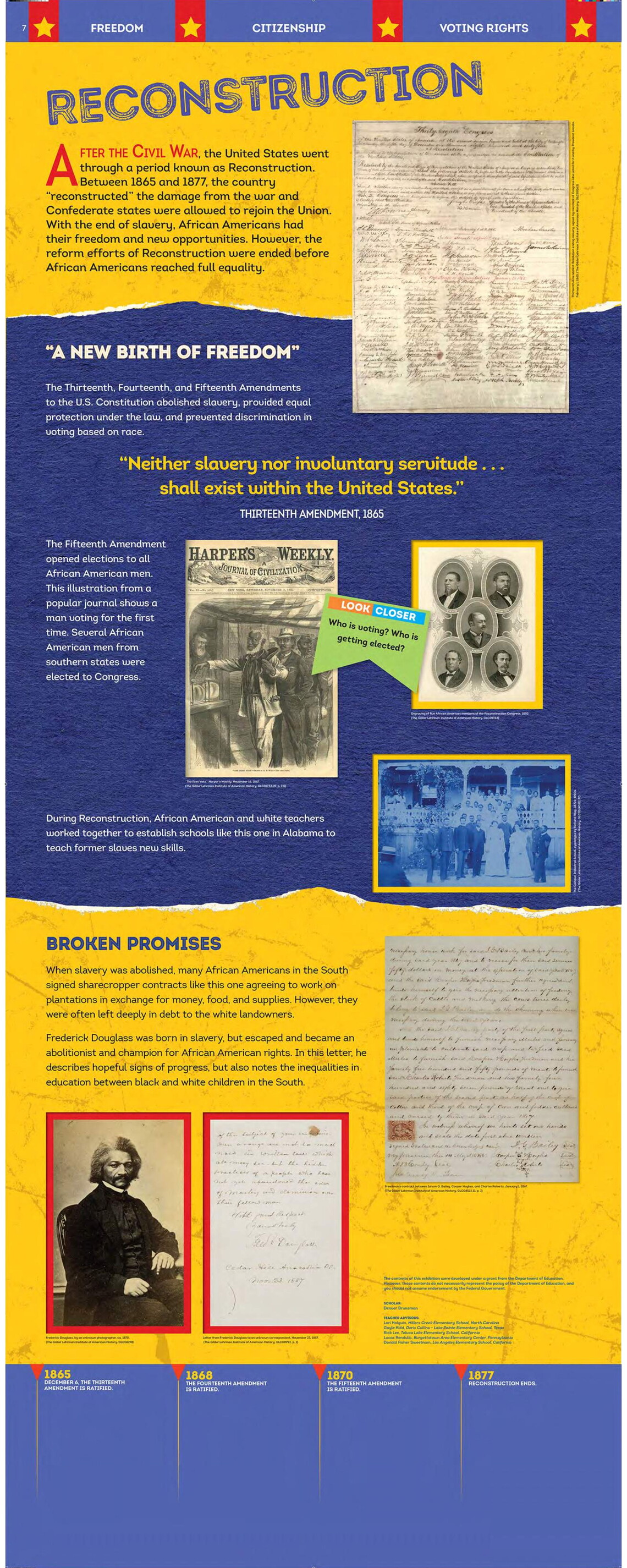
Panel Content
- Thirteenth Amendment Resolution ending slavery signed by members of Congress who voted for it and by President Lincoln, February 1, 1865. (The Gilder Lehrman Institute of American History, GLC00263)
- “Neither slavery nor involuntary servitude . . . shall exist within the United States.” –Thirteenth Amendment, 1865
- “The First Vote,” Harper’s Weekly, November 16, 1867. (The Gilder Lehrman Institute of American History, GLC01733.09, p. 721)
- Engraving of five African American members of the Reconstruction Congress, [1884]. (The Gilder Lehrman Institute of American History, GLC09746)
- The Calhoun Industrial School, cyanotype by Richard Riley, 1870–1900s. (The Gilder Lehrman Institute of American History, GLC05140.02.37)
- Freedmen’s contract between Isham G. Bailey, Cooper Hughs, and Charles Roberts, January 1, 1867. (The Gilder Lehrman Institute of American History, GLC04522.11, p. 2)
- Letter from Frederick Douglass to an unknown correspondent, November 23, 1887. (The Gilder Lehrman Institute of American History, GLC08992, p. 2)
- Frederick Douglass, by an unknown photographer, ca. 1870. (The Gilder Lehrman Institute of American History, GLC06198)
Frequently Asked Questions
If you need more information, please fill out this traveling exhibitions inquiry form. We strive to respond to inquiries within one business day.
Setup Guide
General Questions
Do I need to pay sales tax?
State sales tax laws vary. You may be liable for sales taxes. The Gilder Lehrman Institute will contact you about your potential sales tax obligations.
How can I pay?
We accept credit cards, checks, and purchase orders, but we do not currently accept bank transfers.
Do you offer any discounts or grants?
Unfortunately, we are unable to offer any discounts or grants at this time. We recommend DonorsChoose for schools that need financial assistance to rent or purchase an exhibition.
How do you ship the exhibitions?
Exhibitions are shipped in wheeled cases measuring 15 x 15 x 40 inches and weighing approximately 90 pounds. FedEx handles all shipping. Once your exhibition has shipped, you will receive a tracking number.
How do I set up the exhibition?
We include detailed setup instructions with each rental. Please note that different exhibitions have slightly different setup instructions, so make sure you refer to the correct type of exhibition.
What happens if something breaks after I receive my exhibition?
We are always here to help you troubleshoot or order new parts. The venue will bear the costs of replacement parts due to venue error or excessive wear and tear.
Purchase
What materials are included in my exhibition purchase?
With your purchase, we will order a brand-new exhibition to send to you. Each panel comes in its own zipped sleeve for storage and transport. You will also receive all the supplementary materials typically included with a rental, including the Exhibition Guide and setup instructions.
Does my purchased exhibition come with the travel/storage case?
The travel/storage case is a separate purchase. You can add a case for your exhibition for an additional $500 on the same menu where you bought the exhibition. All exhibitions can fit into one case, except for Freedom: A History of the US, which requires two.
Is shipping included in the purchase price?
Yes!
Can I purchase a “used” exhibition instead of a new one for a lower price?
Occasionally, a limited number of gently used exhibitions are available for purchase at a discounted price. To peruse the current selection of gently used exhibitions, visit the shop. Exhibitions are available on a first-come, first-served basis and are sold as-is.
How long will it take to receive my exhibition?
Once we receive payment, please allow 2 weeks to print and ship your new exhibition. Exhibition orders are not sent for printing until we receive payment in full.
Rental
How long is the rental period?
4 weeks. Please let us know if you would like a longer booking period, and we will do our best to accommodate you! However, we cannot offer discounts for shortened booking periods.
How far in advance should I book my rental?
It is recommended to book 2–3 months in advance of your desired rental date, but we can accept bookings up to a year in advance. Please note that we do not ship exhibitions until payment is received in full, so please keep this in mind when booking your exhibition.
What is included in my rental fee?
The rental cost is a flat fee that covers shipping, the exhibition, and supplemental materials. Extra charges will only occur if a venue damages an exhibition.
Can I bring the exhibition to multiple venues during my rental period?
Exhibitions are limited to the location booked in the contract. While you’re free to relocate the exhibition to different buildings or rooms within your contracted location, we do not permit any other circulation of the exhibition. If you need to feature an exhibition at various locations, we recommend purchasing it rather than renting it.
Can I reschedule my rental?
If your new rental dates are available, we will happily reschedule your rental, provided the exhibition has not already shipped to you.
How do I ship the exhibition back to you?
We’ll send you a FedEx label up to 10 days before the end of your display period and set up a pickup appointment for your exhibition return. Please remove any existing labels from the case before attaching the new one, and notify our team if there are any special instructions for FedEx.