
The United States has often been called “a nation of immigrants”—an oversimplification, to be sure. American Indians were present before the nation’s founding and hundreds of thousands of Africans were brought to these shores in chains. Many Americans, however, descend from immigrants who fled religious or ethnic persecution, war, or economic hardship. Over time, each wave of immigrants has left its own imprint on public attitudes and policies throughout the country’s history. Immigration: An American Story presents documents, maps, and images to tell selected stories of those who came to America, some by force and others by choice in search of a better future for themselves and later generations.
Immigration: An American Story

Purchase: $1,950
Rent: $495
Logistical Information
Size: Seven freestanding retractable panels, each 33" x 81", requiring 21 running feet for display.
Purchase Information: Your institution may purchase a copy of this exhibition for permanent use for $1,950. This includes all panels, supplemental material, and carrying bags for each panel. A travel case is available as a separate purchase.
Rental Information: $495 for a four-week display period
More logistical information can be found in the Immigration: An American Story Exhibition Guide.
Panel One
Immigration: An American Story

Panel Contents
- Henry Gannett, “Proportion of Foreign Born to Total Population of the United States at the Twelfth Census 1900,” Statistical Atlas, Twelfth Census of the United States, Taken in the Year 1900, Washington DC, 1903 (The Gilder Lehrman Institute, GLC09668)
- US Constitution, printed by Dunlap & Claypoole, Philadelphia, PA, September 17, 1787, page 2 (The Gilder Lehrman Institute, GLC03585)
- Dancers at the Saint Patrick’s Day Parade in Chicago, Illinois, March 17, 2018 (Roberto Galan / Shutterstock.com)
- West Indian Day Parade in Brooklyn, New York, August 1, 2014 (A. Katz / Shutterstock.com)
- 84th annual Greek Independence Day Parade in New York, New York, March 29, 2015 (A. Katz/ Shutterstock.com)
- Chinese dragon dance at the 74th Camellia Festival Parade in Los Angeles, California, February 24, 2018 (Kit Leong / Shutterstock.com)
Panel Two
1492 to 17th century
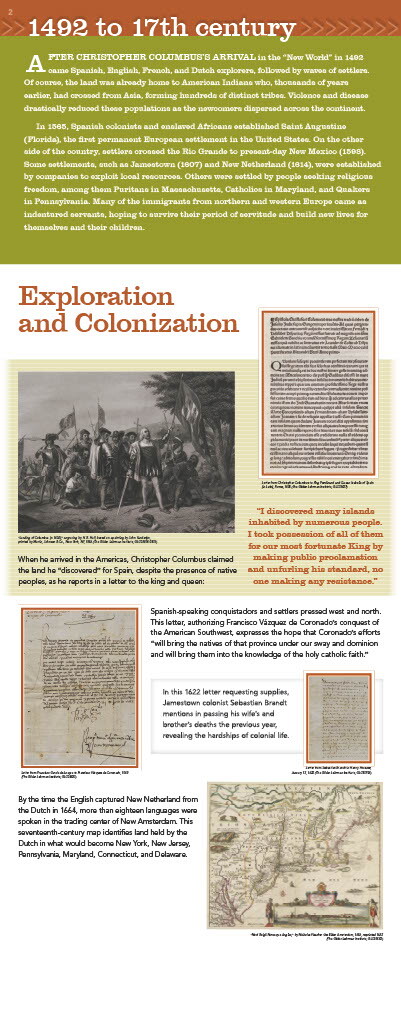
Panel Contents
- Letter from Christopher Columbus to King Ferdinand and Queen Isabella of Spain (in Latin), Rome, 1493 (The Gilder Lehrman Institute, GLCO1427)
- Quote from Christopher Columbus
- “Landing of Columbus [in 1492)” engraving by H. B. Hall, based on a painting by John Vanderlyn, printed by Martin, Johnson & Co., New York, NY, 1856 (The Gilder Lehrman Institute, GLC08878.0001)
- Letter from Francisco García de Loaysa to Francisco Vázquez de Coronado, 1540 (The Gilder Lehrman Institute, GLCO4883)
- Letter from Sebastian Brandt to Henry Hovener, January 13, 1622 (The Gilder Lehrman Institute, GLC00708)
- “Novi Belgii Novaeque Angliae,” by Nicholas Visscher the Elder. Amsterdam, 1656, reprinted 1682 (The Gilder Lehrman Institute, GLCO3582)
Panel Three
18th Century
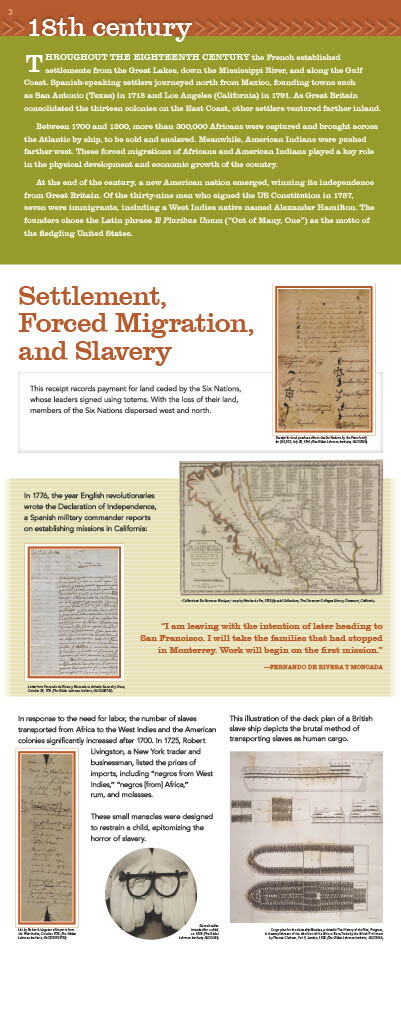
Panel Contents
- Receipt for land purchased from the Six Nations by the Penn family for $10,000, July 28, 1769 (The Gilder Lehrman Institute, GLC02548)
- “Californie et du Nouveau Mexique,” map by Nicolas de Fer, 1700 (Special Collections, The Claremont Colleges Library, Claremont, California)
- Letter from Fernando de Rivera y Moncada to Antonio Bucareli y Ursua, October 20, 1776 (The Gilder Lehrman Institute, GLC06287.08)
- Quote from Fernande de Rivera y Moncada
- List by Robert Livingston of imports from the West Indies, October 1725 (The Gilder Lehrman Institute, GLC03107.01732)
- Slave shackles intended for a child, ca. 1800 (The Gilder Lehrman Institute, GLCO6151)
- Cargo plan for the slave ship Brookes, printed in The History of the Rise, Progress, & Accomplishment of the Abolition of the African Slave-Trade by the British Parliament by Thomas Clarkson, Vol. II, London, 1808 (The Gilder Lehrman Institute, GLC05965)
Panel Four
Early 19th century
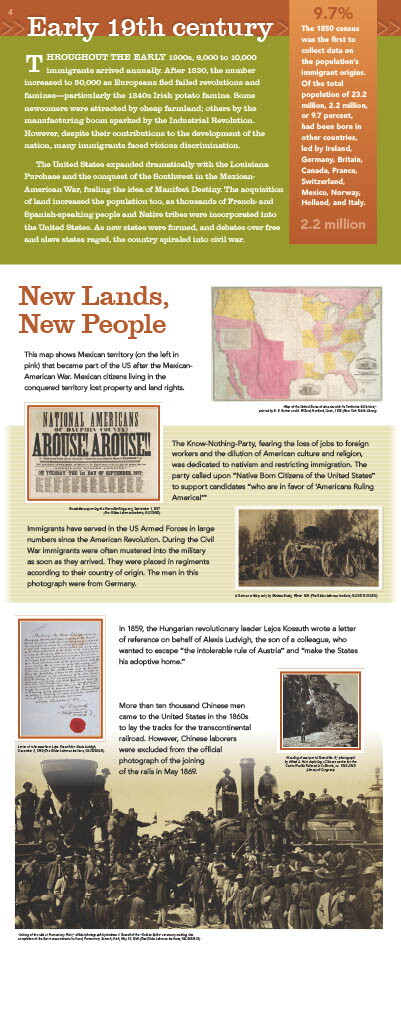
Panel Contents
- “Map of the United States of America with Its Territories & Districts,” printed by B. B. Barber and A. Willard, Hartford, Conn., 1835 (New York Public Library)
- Broadside supporting the Know-Nothing party, September 1, 1857 (The Gilder Lehrman Institute, GLCO9342)
- A German artillery unit, photograph by Mathew Brady, Winter 1861 (The Gilder Lehrman Institute, GLC05111.01.0453)
- Letter of reference from Lajos Kossuth for Alexis Ludvigh, December 3, 1859 (The Gilder Lehrman Institute, GLC02869.01)
- “Heading of east portal Tunnel No. 8,” photograph by Alfred A. Hart depicting a Chinese worker for the Central Pacific Railroad in California, ca. 1865–1869 (Library of Congress)
- “Joining of the rails at Promontory Point,” official photograph by Andrew J. Russell of the “Golden Spike” ceremony marking the completion of the first transcontinental railroad, Promontory Summit, Utah, May 10, 1869 (The Gilder Lehrman Institute, GLCO4481.01)
Panel Five
Late 19th Century
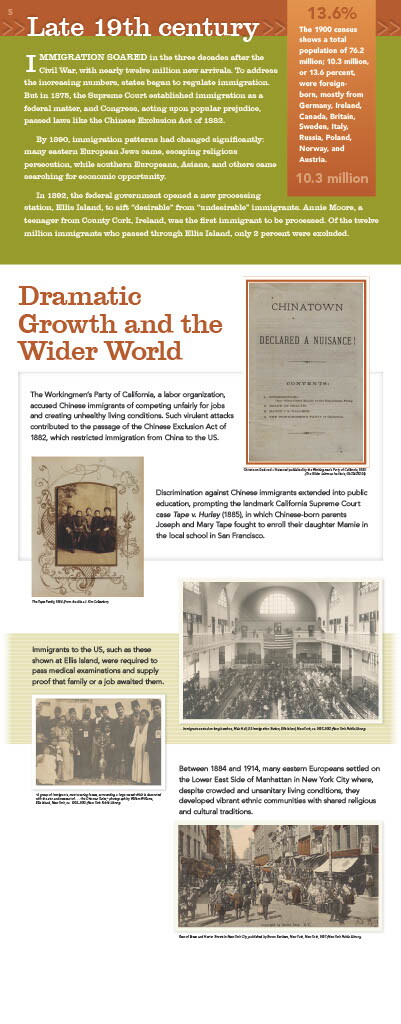
Panel Contents
- Chinatown Declared a Nuisance! published by the Workingmen’s Party of California, 1880 (The Gilder Lehrman Institute, GLCO6232.03)
- The Tape Family, 1884 (From the Alisa J. Kim Collection)
- Immigrants seated on long benches, Main Hall, US Immigration Station, Ellis Island, New York, ca. 1907–1912 (New York Public Library)
- “A group of immigrants, most wearing fezzes, surrounding a large vessel which is decorated with the star and crescent of . . . the Ottoman Turks,” photograph by William Williams, Ellis Island, New York, ca. 1902-1913 (New York Public Library)
- View of Essex and Hester Streets in New York City, published by Brown Brothers, New York, NY, 1907 (New York Public Library)
Panel Six
Early 20th Century

Panel Contents
- Examining Passengers aboard ships at Angel Island, California, Public Health Service Historical Photograph File, 1931 (National Archives)
- “Justice the Issue! Shall Sacco and Vanzetti be Judicially Murdered?” broadside published by the Sacco-Vanzetti Defense Committee, ca. July 1927 (The Gilder Lehrman Institute, GLC05712.01)
- “Sometimes I tell my children that I would like to go to Mexico, but they tell me ‘We don’t want to go, we belong here.’”
- Mexican mother in California. Photograph and caption by Dorothea Lange, June 1935 (Library of Congress)
- Japanese internment broadside, May 3, 1942 (The Gilder Lehrman Institute, GLC06360)
- Japanese-Americans transferring from train to bus at Lone Pine, California, bound for the war relocation authority center at Manzanar, photograph attributed to Clem Albers, US War Relocation Authority, April 1942 (Library of Congress)
Panel Seven
1965 Onward

Panel Contents
- Vietnamese refugees awaiting rescue from their fishing boat after eight days at sea. From the Records of the Office of the Secretary of Defense, May 15, 1984 (National Archives)
- Lester Holmes and family (Private Collection)
- Quote from Lester Holmes
- Soussan Semerciyan, ca. 1983 (Private Collection)
- Quote from Soussan Semerciyan
- Passport photo of V. Venugopal (Private Collection)
- Passport photo of Lakshmi Venugopal (Private Collection)
- Quote from V. Venugopal
- Activists rallying in support of the immigrant community, Portland, Oregon, September 5, 2017 (Diego G Diaz /Shutterstock.com)
Frequently Asked Questions
If you need more information, please fill out this traveling exhibitions inquiry form. We strive to respond to inquiries within one business day.
Setup Guide
General Questions
Do I need to pay sales tax?
State sales tax laws vary. You may be liable for sales taxes. The Gilder Lehrman Institute will contact you about your potential sales tax obligations.
How can I pay?
We accept credit cards, checks, and purchase orders, but we do not currently accept bank transfers.
Do you offer any discounts or grants?
Unfortunately, we are unable to offer any discounts or grants at this time. We recommend DonorsChoose for schools that need financial assistance to rent or purchase an exhibition.
How do you ship the exhibitions?
Exhibitions are shipped in wheeled cases measuring 15 x 15 x 40 inches and weighing approximately 90 pounds. FedEx handles all shipping. Once your exhibition has shipped, you will receive a tracking number.
How do I set up the exhibition?
We include detailed setup instructions with each rental. Please note that different exhibitions have slightly different setup instructions, so make sure you refer to the correct type of exhibition.
What happens if something breaks after I receive my exhibition?
We are always here to help you troubleshoot or order new parts. The venue will bear the costs of replacement parts due to venue error or excessive wear and tear.
Purchase
What materials are included in my exhibition purchase?
With your purchase, we will order a brand-new exhibition to send to you. Each panel comes in its own zipped sleeve for storage and transport. You will also receive all the supplementary materials typically included with a rental, including the Exhibition Guide and setup instructions.
Does my purchased exhibition come with the travel/storage case?
The travel/storage case is a separate purchase. You can add a case for your exhibition for an additional $500 on the same menu where you bought the exhibition. All exhibitions can fit into one case, except for Freedom: A History of the US, which requires two.
Is shipping included in the purchase price?
Yes!
Can I purchase a “used” exhibition instead of a new one for a lower price?
Occasionally, a limited number of gently used exhibitions are available for purchase at a discounted price. For the current selection of gently used exhibitions, visit the shop. Exhibitions are available on a first-come, first-served basis and are sold as-is.
How long will it take to receive my exhibition?
Once we receive payment, please allow 2 weeks to print and ship your new exhibition. Exhibition orders are not sent for printing until we receive payment in full.
Rental
How long is the rental period?
4 weeks. Please let us know if you would like a longer booking period, and we will do our best to accommodate you! However, we cannot offer discounts for shortened booking periods.
How far in advance should I book my rental?
It is recommended to book 2–3 months in advance of your desired rental date, but we can accept bookings up to a year in advance. Please note that we do not ship exhibitions until payment is received in full, so please keep this in mind when booking your exhibition.
What is included in my rental fee?
The rental cost is a flat fee that covers shipping, the exhibition, and supplemental materials. Extra charges will only occur if a venue damages an exhibition.
Can I bring the exhibition to multiple venues during my rental period?
Exhibitions are limited to the location booked in the contract. While you’re free to relocate the exhibition to different buildings or rooms within your contracted location, we do not permit any other circulation of the exhibition. If you need to feature an exhibition at various locations, we recommend purchasing it rather than renting it.
Can I reschedule my rental?
If your new rental dates are available, we will happily reschedule your rental, provided the exhibition has not already shipped to you.
How do I ship the exhibition back to you?
We’ll send you a FedEx label up to 10 days before the end of your display period and set up a pickup appointment for your exhibition return. Please remove any existing labels from the case before attaching the new one, and notify our team if there are any special instructions for FedEx.