
“The Power to Make Money is a Gift from God”: The Life and Fortune of John D. Rockefeller
by Grant Segall
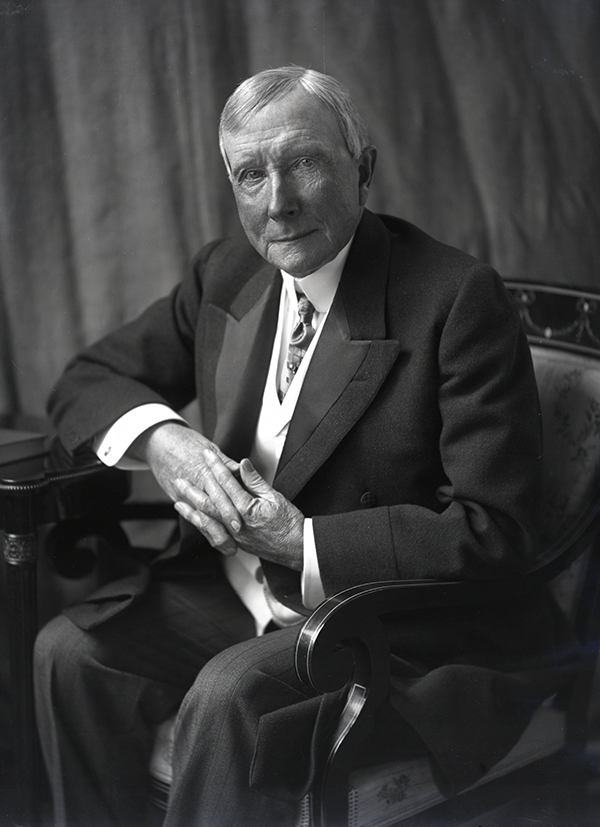 When John D. Rockefeller was about seven years old, he spied turkeys sneaking through the brush on his family’s farm.
“I can still close my eyes,” he would write in his memoirs, “and distinctly see the gentle and dignified birds walking quietly along the brook and through the woods, cautiously stealing the way to their nests.”[1]
John was gentle, dignified, quiet, and cautious himself. He stalked a zigzagging hen a couple of times and finally found her nest. He brought it and her into the barn. He fed the hatchlings and walked them. He eventually sold them and bought three more hens.
It was the start of the biggest fortune amassed to its day. Biographer Ron Chernow estimated that Rockefeller’s wealth peaked in 1913 at $900 million, worth more than $29 billion in 2025.[2] The oilman was also one of history’s biggest benefactors, donating an estimated $540 million.[3]
Rockefeller as much as anyone modernized, centralized, and globalized industry and charity. He led the rise of trusts, holding companies, foundations, matching grants, and industrial and philanthropic research.
“I believe the power to make money is a gift from God,” he said. “I believe it is my duty to make money and still more money, and to use the money I make for the good of my fellow man according to the dictates of my conscience.”[4]
John Davison Rockefeller was born on July 8, 1839, the second of six children. He was raised in central New York and Cleveland. His father peddled potions known as snake oil, fathered two children with a servant, was indicted for rape but never tried, often vanished, and finally stayed away.
John was tall, stooped, and spindly, with hooded blue eyes. He sold candy to his siblings, dug a neighbor’s potatoes, and lent him money at interest. He attended high school and business school. On September 26, 1855, at age sixteen, he became a clerk at a wholesale firm. He later celebrated the anniversaries of this “Job Day.”
At nineteen, Rockefeller co-founded a wholesale firm, selling beans, plaster, and more. He spent most waking hours working except on the Sabbath. He taught Baptist Sunday school and became a church trustee. He shunned liquor, tobacco, and cards. He donated to different faiths, races, and nationalities, partly to buy enslaved people’s freedom. But he hired a substitute for the Civil War.
In 1859, the world’s first oil strike gushed near Titusville, Pennsylvania. Four years later, Rockefeller and partners started refining oil in Cleveland, about 105 miles west. He wangled discounts on his rail shipments and rebates and commissions on his rivals’. He borrowed millions and pinched pennies to make both grow. He persuaded workers to seal oil cans with thirty-nine drops of solder instead of forty. His company was soon producing 10 percent of the world’s refined oil.
In 1864, he married an old schoolmate, Laura Celestia Spelman, born to prominent abolitionists. The Rockefellers had five children, one of whom died in infancy. Laura was a founding member of the Women’s Christian Temperance Union. She and John knelt at saloons and prayed for the gathered sinners. He also supported a school for Black women that became Spelman College, named for her family.
In 1870, Standard Oil was incorporated with Rockefeller as president. Partners in the privately held business included one of his brothers and Henry Flagler, who later developed much of South Florida.
Their early attempt to monopolize Pennsylvania’s oil was quashed by lawmakers and mobs of vandals. But they scooped up nearly every Cleveland refinery early on. Rockefeller later said, “The Standard was an angel of mercy, reaching down from the sky, and saying: ‘Get into the ark.’”[5]
Drilling wells, controlling supplies, underselling competitors, using spies and fronts, and laying pipelines to bypass railroads, Standard became a vertical and horizontal monopoly and the world’s biggest business. It grew to employ more than 100,000 workers and produce 90 to 95 percent of all refined oil.[6]
“I believe in the spirit of combination and cooperation when properly and fairly conducted,” Rockefeller wrote. “It helps to reduce waste; and waste is a dissipation of power.”[7]
He paid workers relatively well but forbid them to combine and cooperate in unions. Unlike many robber barons, he shunned stock speculations and manipulations. He preferred small dividends and big reinvestments.
For years, his biggest product was kerosene for lamps. He called Standard “missionaries of light.”[8] Its more than 300 other products included tar, asphalt, lubricants, wax, Vaseline, ingredients for chewing gum, natural gas for streetlights, stoves, and furnaces, and gasoline for cars and airplanes.
In the 1880s, Rockefeller and Standard moved to Manhattan, near the nation’s biggest markets and banks. He gradually assembled estates up to nearly five square miles outside Cleveland and New York City and in coastal New Jersey and Florida.
!["Next!" by Udo J. Keppler, illustration in Puck, September 7, 1904 (Library of Congress) [According to the website of the Library of Congress, this cartoon "shows a Standard Oil storage tank as an octopus with many tentacles wrapped around the steel, copper, and shipping industries, as well as a state house, and the US Capitol, and one tentacle reaching for the White House."]](/sites/default/files/2025-12/Octopus_LOC.jpg) Standard weathered countless attacks. The New York World called it “the most cruel, impudent, pitiless, and grasping monopoly.”[9] Of Standard’s pious president, the slang humorist Finley Peter Dunne wrote, “He’s a kind iv a society f’r th’ previntion of croolty to money.”[10] Muckrakers claimed unfairly that Rockefeller had fleeced a refiner’s widow. The postal service intercepted a letter bomb meant for him.
Standard weathered countless attacks. The New York World called it “the most cruel, impudent, pitiless, and grasping monopoly.”[9] Of Standard’s pious president, the slang humorist Finley Peter Dunne wrote, “He’s a kind iv a society f’r th’ previntion of croolty to money.”[10] Muckrakers claimed unfairly that Rockefeller had fleeced a refiner’s widow. The postal service intercepted a letter bomb meant for him.
Rockefeller usually responded with silence or vagueness. He told a court about Standard, “I believe, your Honor, they operate an oil refinery.”[11]
Pennsylvania indicted Standard’s leaders for monopoly but settled the case. Congress passed the Interstate Commerce Act and Sherman Antitrust Act. Standard bought time by becoming a trust, then a holding company.
Rockefeller lived lavishly but cheaply. He wore monogrammed onyx cufflinks and paper vests. He once scolded a young newsboy for lacking change. The boy grew up to be the frugal and wealthy Bob Hope.
Rockefeller stayed fit by swimming, skating, bicycling, golfing, and plying an exercise machine. He consumed mild fare like apples and barley water. In his fifties, though, he had a few ailments and lost all his hair, even his eyebrows. He gradually and unofficially retired.
His diverse investments included Minnesota iron. In 1901, hiding behind his bushes in rural New York with Henry Clay Frick, he negotiated its sale to the forthcoming US Steel. He later quit US Steel’s board and sold his shares, resenting the lavish dividends.[12]
Some investments hurt Rockefeller’s wallet or reputation. His family controlled Colorado Fuel and Iron, where guards killed twenty-one strikers, wives, and children in 1914.
In 1907, Standard was fined $29.2 million, worth more than $1 billion today. Then the fine was quashed. In 1911, the US Supreme Court broke Standard into thirty-four companies. They went public, and their stocks soared.
Rockefeller’s gifts kept mounting. He founded the University of Chicago and what became Rockefeller University and Central Philippine University. He created the world-leading Rockefeller Foundation and other charities, supporting education, agriculture, healthcare, and more. He lent millions to ease financial panics. At a publicist’s suggestion, he gave coins to strangers.
After twenty-two years as a widower, Rockefeller died at ninety-seven on May 23, 1937, at home in Ormond Beach, Florida. He was buried in Cleveland’s Lake View Cemetery beside a granite obelisk sixty-six feet tall. To this day, people leave coins there, perhaps to repay or propitiate him.
His legacy has lasted. Descendants have held the vice presidency, three governorships, and a US Senate seat. Monopolies continue to reign, and some old Standard companies survive, including Chevron and the re-merged ExxonMobil. But oil’s environmental damage has prompted the Rockefeller Foundation to divest from it.
Biographers have given Rockefeller mixed reviews. Chernow called him “an amalgam of godliness and greed.”[13] David Freeman Hawke said the tycoon “cheated and lied his way to a great fortune” but was “the most upright of all American industrialists.”[14] Judging by his own words, Rockefeller seemed thoroughly convinced that he made the world much better by both his charity and his industry.
Grant Segall is the author of John D. Rockefeller: Anointed with Oil (Oxford University Press, 2001). He spent forty-three years as a daily journalist, mostly with the Cleveland Plain Dealer. He has written for Time, The Washington Post, Science, The Daily Beast, The Boston Globe, Reuters, American Education, Inside Climate News, and many other outlets. He has won three national awards and been named Ohio’s best freelance journalist.
[1] John D. Rockefeller, Random Reminiscences of Men and Events (Doubleday, Page & Company, 1909), 34.
[2] Ron Chernow, Titan: The Life of John D. Rockefeller, Sr. (Random House, 1998), 556.
[3] Rockefeller Archive Center, “John D. Rockefeller, 1839–1937.”
[4] John T. Flynn, God’s Gold: The Story of Rockefeller and His Times (Harcourt, Brace and Company, 1932), 401.
[5] Allan Nevins, John D. Rockefeller: The Heroic Age of American Enterprise (Charles Scribner’s Sons, 1940), vol. 1, 373.
[6] Henry J. Sage, “The Richest Man in the World,” Sage American History (2017); Grant Segall, John D. Rockefeller: Anointed with Oil (Oxford University Press, 2001), 48.
[7] Grant Segall, John D. Rockefeller: Anointed with Oil, 155.
[8] Rockefeller Archive Center, John D. Rockefeller interview with William O. Inglis, 1917–20, 274.
[9] Henry J. Sage, “The Richest Man in the World,” Sage American History, 2017.
[10] Finley Peter Dunne, “The Big Fine,” Mr. Dooley Says (Charles Scribner’s Sons, 1910).
[11] Ron Chernow, Titan: The Life of John D. Rockefeller, Sr., 541.
[12] Grant Segall, John D. Rockefeller: Anointed with Oil, 83.
[13] Ron Chernow, Titan: The Life of John D. Rockefeller, Sr., 675.
[14] David Freeman Hawke, John D.: The Founding Father of the Rockefellers (Harper & Row, 1980), 221.


