Frederick Douglass: Advocate for Equality

Frederick Douglass: Advocate for Equality

Frederick Douglass: Advocate for Equality explores Douglass’s epic life from 1818 to 1895.


This exhibition examines Douglass’s escape from slavery, his work as an abolitionist, and his relentless fight for equality for all individuals during the Jim Crow era.

a photo of the entire Douglass exhibition
  • Purchase: $1,875

  • Rent: $495

Logistical Information

Size: Six freestanding retractable panels, each 33" x 81", requiring 18 running feet for display.

Purchase Information: Your institution may purchase a copy of this exhibition for permanent use for $1,875. This includes all panels, supplemental material, and carrying bags for each panel. A travel case is available as a separate purchase.

Purchase Exhibition

Gently Used Exhibitions: The Gilder Lehrman Institute is offering selected used copies of this exhibition for 75% off the purchase price! These exhibitions have previously traveled the country as part of our rental program and remain in good condition. Used exhibitions are available for purchase on a first-come, first-served basis. Photographs are available in the shop for you to review your exhibition before purchasing. Visit the shop now to claim your copy. 

Shop Used Exhibitions

Rental Information: $495 for a four-week display period

Rent Your Copy

More information can be found in the Frederick Douglass Exhibition Guide.

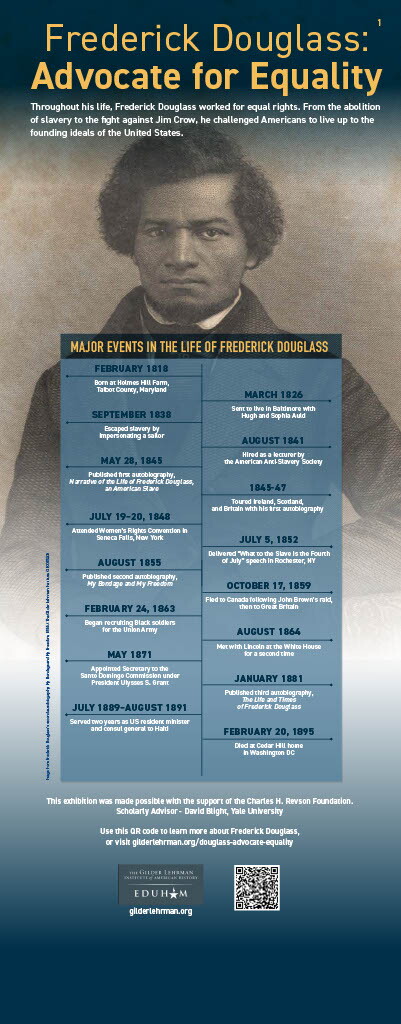
Panel One

Frederick Douglass: Advocate for Equality 

Douglass_Panel 1.

Panel Contents

  • February 1818: Born at Holmes Hill Farm, Talbot County, Maryland
  • March 1826: Sent to live in Baltimore with Hugh and Sophia Auld
  • September 1838: Escaped slavery by impersonating a sailor
  • August 1841: Hired as a lecturer by the American Anti-Slavery Society
  • May 28, 1845: Published first autobiography, Narrative of the Life of Frederick Douglass, an American Slave
  • 1845–1847: Toured Ireland, Scotland, and Britain with his first autobiography
  • July 19–20, 1848: Attended Women’s Rights Convention in Seneca Falls, NY 
  • July 5, 1852: Delivered “What to the Slave is the Fourth of July” speech in Rochester, NY
  • August 1855: Published second autobiography, My Bondage and My Freedom
  • October 17, 1859: Fled to Canada following John Brown’s raid, then to Great Britain
  • February 24, 1863: Began recruiting Black soldiers for the Union Army
  • August 1864: Met with Lincoln at the White House for a second time
  • May 1871: Appointed Secretary to the Santo Domingo Commission under President Ulysses S. Grant
  • January 1881: Published third autobiography, The Life and Times of Frederick Douglass
  • July 1889–August 1891: Served two years as US resident minister and consul general to Haiti
  • February 20, 1895: Died at Cedar Hill home in Washington, DC 

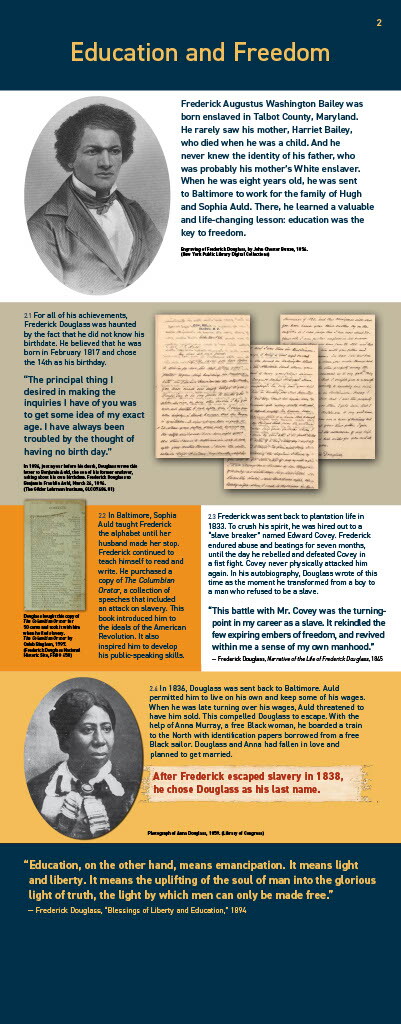
Panel Two

Education and Freedom

Douglass_Panel 2

Panel Contents

  • Frederick Douglass to Benjamin Franklin Auld, March 24, 1894. (The Gilder Lehrman Institute, GLC07484.01)
  • Quote from Frederick Douglass to Benjamin Franklin Auld
  • The Columbian Orator by Caleb Bingham, 1797. (Frederick Douglass National Historic Site, FRDO 650)
  • Quote from Narrative of the Life of Frederick Douglass by Frederick Douglass, 1845
  • Photograph of Anna Douglass, 1859. (Library of Congress)
  • Quote from “Blessings of Liberty and Education,” by Frederick Douglass, 1894.

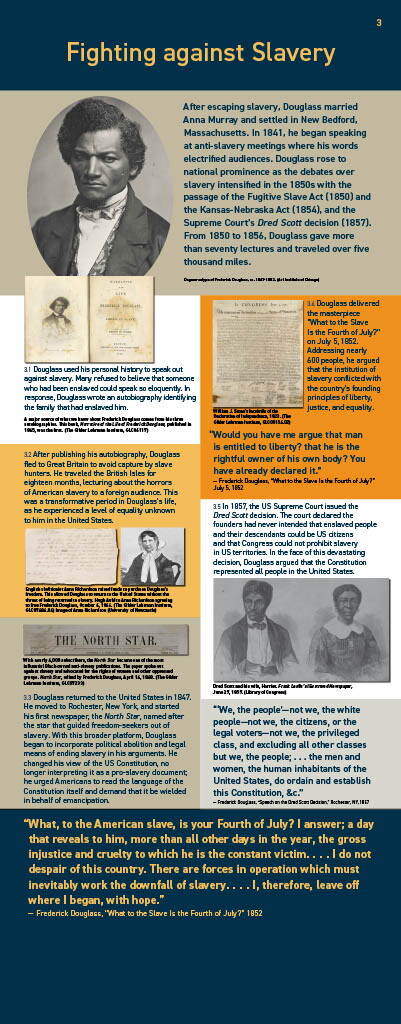
Panel Three

Fighting against Slavery 

Douglass_Panel 3.

Panel Contents

  • Narrative of the Life of Frederick Douglass by Frederick Douglass, 1845. (The Gilder Lehrman Institute, GLC06117)
  • Hugh Auld to Anna Richardson, agreeing to free Frederick Douglass, October 6, 1846. (The Gilder Lehrman Institute, GLC07484.04)
  • Image of Anna Richardson. (University of Newcastle)
  • The North Star, edited by Frederick Douglass, April 14, 1848. (The Gilder Lehrman Institute, GLC07233)
  • William J. Stone’s facsimile of the Declaration of Independence, 1823. (The Gilder Lehrman Institute, GLC00154.02)
  • Dred Scott and his wife, Harriet, Frank Leslie’s Illustrated Newspaper, June 27, 1857. (Library of Congress) 
  • Quote from Frederick Douglass, “What to the Slave Is the Fourth of July?" Speech, 1852.

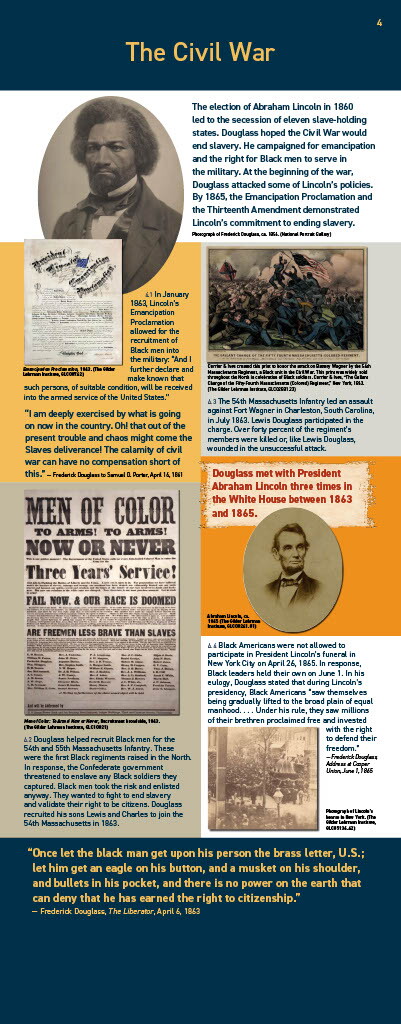
Panel Four

The Civil War 

Douglass_Panel 4

Panel Contents

  • Photograph of Frederick Douglass, ca. 1856. (National Portrait Gallery)
  • Emancipation Proclamation of 1863 [California Printing, Cheesman copy], San Francisco, 1864. (The Gilder Lehrman Institute, GLC00742) 
  • Men of Color: To Arms! Now or Never recruitment broadside, 1863. (The Gilder Lehrman Institute, GLC10021)
  • Currier & Ives, The Gallant Charge of the Fifty-Fourth Massachusetts (Colored) Regiment, New York, 1863. (The Gilder Lehrman Institute, GLC02881.23)
  • Portrait of Abraham Lincoln, ca. 1865. (The Gilder Lehrman Institute, GLC00241.01)
  • Photograph of Lincoln’s hearse in Philadelphia, Pennsylvania, Wilson & Hood, 1865. (The Gilder Lehrman Institute, GLC05136.27)

Panel Five

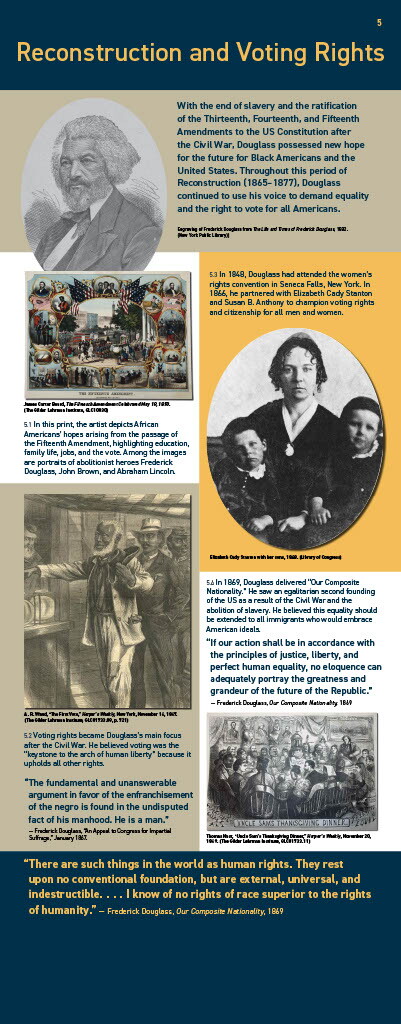
Reconstruction and Voting Rights 

Douglass_Panel 5

Panel Contents

  • Engraving of Frederick Douglass from The Life and Times of Frederick Douglass, 1882. (New York Public Library)
  • James Carter Beard, The Fifteenth Amendment Celebrated May 19 1870, 1870. (The Gilder Lehrman Institute, GLC10030) 
  • A. R. Waud, “The First Vote,” Harper’s Weekly, November 16, 1867. (The Gilder Lehrman Institute, GLC01733.09, pg. 721) 
  • Elizabeth Cady Stanton with her sons, 1848. (Library of Congress)
  • Thomas Nast, “Uncle Sam’s Thanksgiving Dinner,” Harper’s Weekly, November 20, 1869. (The Gilder Lehrman Institute, GLC01733.11)

Panel Six

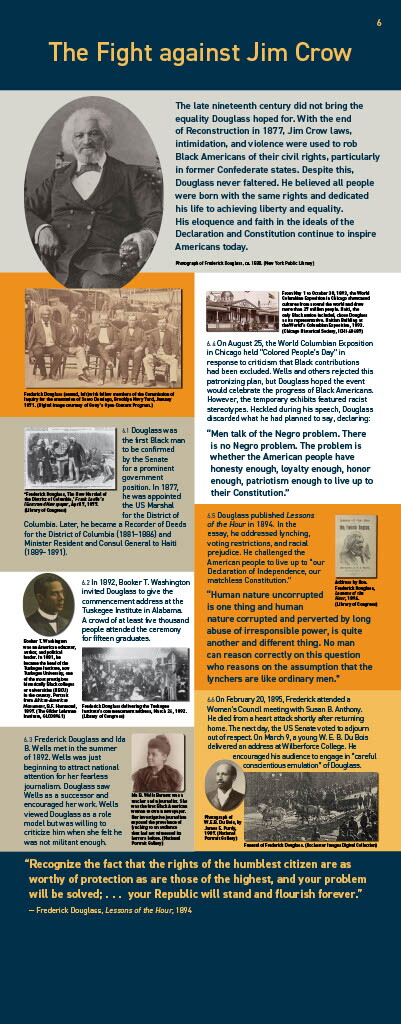
The Fight against Jim Crow

Douglass_Panel 6

Panel Contents

  • Photograph of Frederick Douglass, ca. 1880. (New York Public Library)
  • Frederick Douglass (seated, left) with the Commissioners to Santo Domingo, Brooklyn Navy Yard, January 1871. (Digital image courtesy of Getty’s Open Content Program)
  • “Frederick Douglass, The New Marshal of the District of Columbia,” Frank Leslie’s Illustrated Newspaper, April 7, 1877 (Library of Congress)
  • Portrait of Booker T. Washington from the African-American Monument, B. F. Hammond, 1897. (The Gilder Lehrman Institute, GLC08941) 
  • Ida B. Wells Barnett, 1893. (National Portrait Gallery)
  • Frederick Douglass delivering the Tuskegee Institute’s commencement address, March 26, 1892. (Library of Congress) 
  • Haitian Building at the World’s Columbian Exposition, 1893. (Chicago Historical Society, ICHI-40687).
  • Address by the Hon. Frederick Douglass, “Lessons of the Hour,” 1894. (Library of Congress)
  • Photograph of W. E. B. Du Bois by James E. Purdy, 1907. (National Portrait Gallery)
  • Funeral of Frederick Douglass, 1895. (Rochester Images Digital Collection)

Exhibition Resources

These resources have been curated to offer documents, videos, reading suggestions, and more for the Frederick Douglass: Advocate for Equality exhibition and any GLI patron interested in learning more about Douglass’s remarkable life and works.

Historical Documents

The Gilder Lehrman Collection contains many documents on the life and work of Frederick Douglass. The following Spotlights on Primary Sources provide a closer look at some of those documents.

Buying Frederick Douglass’s freedom, 1846
In 1846, Douglass’s friends in Great Britain negotiated to purchase his freedom from the Auld family in Maryland.

“I love you but hate slavery”: Frederick Douglass to his former owner, Hugh Auld, ca. 1860
In this letter, Douglass writes to Hugh Auld, whose family had enslaved him, to try to get information about his birthdate.

Racism in the North: Frederick Douglass on “a vulgar and senseless prejudice,” 1870
Frederick Douglass wrote to the manager of the Star Course lecture series at the Academy of Music in Philadelphia, refusing to speak if Black audience members were not admitted on the same terms as White audience members.

Frederick Douglass on Jim Crow, 1887
Frederick Douglass witnessed and decried the encroachment of Jim Crow laws in the decade following the end of Reconstruction. In this letter, he recognizes some advances made in the South but calls out the ongoing inequalities.

Frederick Douglass on the disfranchisement of Black voters, 1888
In this 1888 letter, Frederick Douglass protested the disfranchisement of Black voters in the South a decade after Reconstruction ended. 

Selected Essays

Many essays about Frederick Douglass and his times have been published on the Gilder Lehrman Institute website and in History Now, the institute’s online journal. The selected essays below provide teachers, students, and general readers with a historical perspective.

Frederick Douglass: An Example for the Twenty-First Century by Noelle N. Trent (National Civil Rights Museum)

Director of Interpretation, Collections, and Education at the National Civil Rights Museum at the Lorraine Motel, Noelle N. Trent writes about Frederick Douglass’s legacy and influence on the present day in this essay.

“The Merits of This Fearful Conflict”: Douglass on the Causes of the Civil War by David Blight (Yale University)

Historian David Blight discusses Douglass’s reflection on the Civil War and his fear that Americans were forgetting about the root causes of the war in their efforts to reconcile the North and the South.

Frederick Douglass: From Slavery to Freedom by Steven Mintz (University of Texas at Austin)

Historian Steven Mintz writes about Douglass’s journey from being enslaved to becoming one of the most prominent Black activists of his time.

The Lion of All Occasions: The Great Black Abolitionist Frederick Douglass by Manisha Sinha (University of Connecticut)

Historian Manisha Sinha writes about Douglass’s work as an abolitionist in this essay from the Winter 2018 issue of History Now, “Frederick Douglass at 200.”

Douglass the Autobiographer by Robert S. Levine (University of Maryland, College Park)

Professor Robert S. Levine discusses Frederick Douglass’s autobiographies and writing in this essay from the Winter 2018 issue of History Now, “Frederick Douglass at 200.”

Frederick Douglass, Orator by Sarah Meer (University of Cambridge)

Sarah Meer, a professor of nineteenth-century literature, explores Douglass’s work through his speeches. 
Programming Ideas

Community Programming Ideas 

  • Host a Community Book Program before and/or during the exhibit using any of Douglass’s own autobiographies or biographies. You may consider choosing an additional title for young adults and children. Please see the bibliography included in this Site Support Notebook for biography and other book ideas.
  • Create displays or complementary programming based upon the following:
    • Black soldiers in the Civil War
    • Jim Crow era laws and their impacts
    • Ida B. Wells and her continued fight for civil rights following Douglass’s death
  • Host this exhibition as part of Black History Month programming in February, also highlighting the influential figures Douglass worked with during his life. Other figures to feature might include Ida B. Wells, Booker T. Washington, W. E. B. Du Bois, Sojourner Truth, and Harriet Tubman.
  • One of Douglass’s core beliefs was that voting should be a right and is one of the most powerful ways to influence the world around us. Host a voting registration drive alongside the exhibition in honor of Douglass’s belief in the power of voting.

Student Programming Ideas

  • Have a group of students read each of Douglass’s autobiographies. Hold a discussion in which students can compare and contrast his own narrative of his life as he aged and the fight for equality continued.
  • Create a scavenger hunt using key quotes, images, and facts from Douglass’s life. Challenge students to find the answers on the panels while they view the exhibition.
  • During his own life, Douglass’s views on whether or not the constitution itself enumerated universal voting rights changed. Use this change in viewpoints to teach students about interpreting the US Constitution and the complexity of using one document to determine the fate of a rapidly expanding and changing nation. 

Setup Guide & FAQ 

If you need more information, please fill out this traveling exhibitions inquiry form. We strive to respond to inquiries within one business day. 

Setup Guide

General Questions

What are the costs?
• To Rent: $495/four weeks for most exhibitions; $995/four weeks for Freedom: A History of the United States
To Buy: Alexander Hamilton, Frederick Douglass, and World War I are available for $1,875. Becoming the US, Cold War, Declaration 1776, Immigration, Who Can Vote, and World War II are available for $1,950. Freedom: A History of US is available for $2,950. A wheeled travel case is available as a separate purchase for $500.

Do I need to pay sales tax?
State sales tax laws vary. You may be liable for sales taxes. The Gilder Lehrman Institute will contact you about your potential sales tax obligations.

How can I pay?
We can accept credit cards, checks, or purchase orders, but we cannot currently accept bank transfers.

Do you offer any discounts or grants?
Unfortunately, we cannot offer any discounts or grants at this time. We recommend Donors Choose for schools needing financial assistance to rent or purchase an exhibition.

How do you ship the exhibitions?
Exhibitions are shipped in wheeled cases measuring 15 x 15 x 40 inches and weighing approximately 90 pounds. FedEx handles all shipping. Once your exhibition has shipped, you will receive a tracking number.

How do I set up the exhibition?
We include detailed setup instructions with each rental. Please note that different exhibitions have slightly different setup instructions, so make sure you refer to the correct type of exhibition.

What happens if something breaks after I receive my exhibition?
We are always here to help you troubleshoot or order new parts. The venue will bear the costs of replacement parts due to venue error or excessive wear and tear.

Purchase

How much does it cost to purchase this exhibition?
$1,875 for a copy of this exhibition for permanent use.

What materials are included in my exhibition purchase?
With your purchase, we order a brand new exhibition to send you. Each panel comes in its own zipped sleeve for storage and transport. You will also receive all the supplementary materials you would receive with a rental, including the Exhibition Guide and setup instructions.

What are the dimensions of the exhibition?
Six freestanding retractable panels, each 33" x 81", requiring a minimum of 15–18 running feet for display.

Does my purchased exhibition come with the travel/storage case?
The travel/storage case is a separate purchase. You can add a case for your exhibition for an additional $375 on the same menu where you bought the exhibition. All exhibitions can fit into one case except Freedom: A History of the US, which needs two.

Is shipping included in the purchase price?
Yes!

Can I purchase a “used” exhibition instead of a new one for a lower price?
Occasionally, a limited number of gently used exhibitions are available for purchase at a discounted price. For the current selection of gently used exhibitions, visit the shop. Exhibitions are available on a first-come, first-served basis and are sold as-is. 

How long will it take to receive my exhibition?
Once we receive payment, please allow 2 weeks to print and ship your new exhibition. Exhibition orders are not sent for printing until we receive payment in full.

Rental

How much does it cost to rent this exhibition?
$450

How long is the rental period?
4 weeks. Please let us know if you would like a longer booking period, and we will do our best to accommodate you! However, we cannot offer discounts for shortened booking periods.

How far in advance should I book my rental?
It is best to book 2–3 months before your desired rental date, but we can accept bookings up to a year in advance. Please note that we do not ship exhibitions until they have been paid in full, so keep this in mind when booking your exhibition.

What is included in my rental fee?
The rental cost is a flat fee that covers shipping, the exhibition, and supplemental materials. Extra charges will only occur if a venue damages an exhibition.

What are the dimensions of the exhibition?
Six freestanding retractable panels, each 33" x 81", requiring a minimum of 15–18 running feet for display.

Can I bring the exhibition to multiple venues during my rental period?
Exhibitions are limited to the location booked in the contract. While you’re free to move the exhibition to different buildings or rooms within your contracted location, we do not allow any circulation of the exhibition otherwise. If you need to feature an exhibition at various locations, we recommend purchasing it rather than renting it.

Can I reschedule my rental?
If your new rental dates are available, we will happily reschedule your rental, provided the exhibition has not already shipped to you.

How do I ship the exhibition back to you?
We’ll send you a FedEx label up to 10 days before the end of your display period and set up a pickup appointment for your exhibition return. Please remove any labels from the case before attaching the new one, and let our team know if there are any special instructions for FedEx.