
The Making of a Great Nation: Anna Rosenberg’s Social Equality Through Economic Opportunity
by Christopher C. Gorham
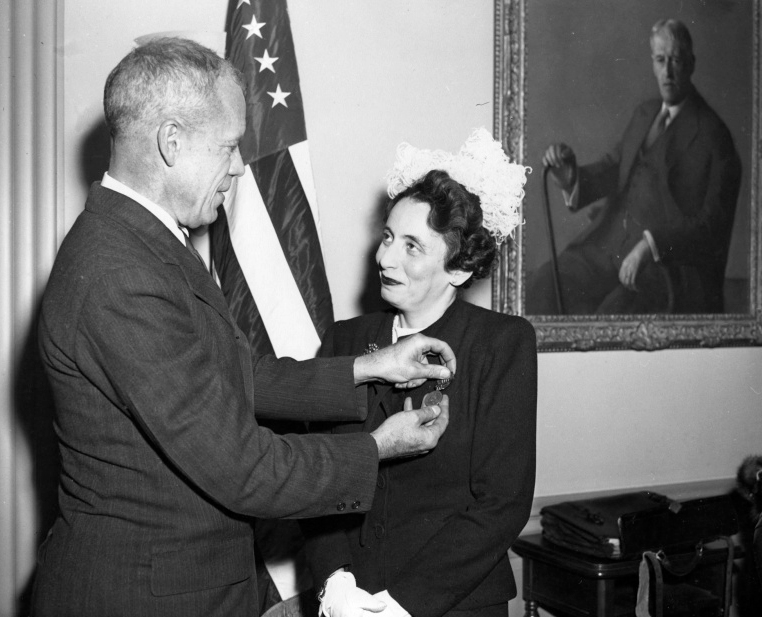
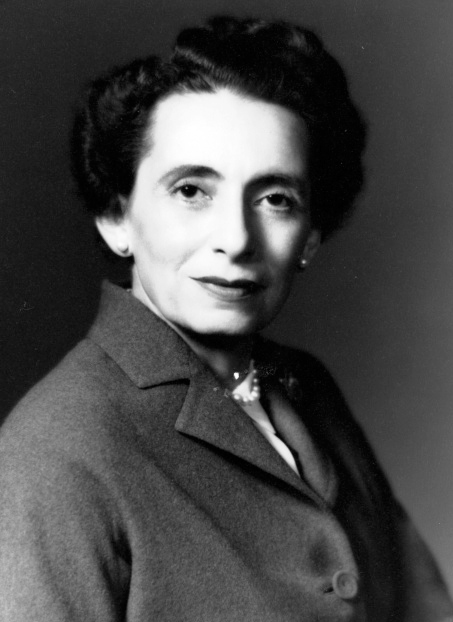 When Anna Rosenberg died in May 1983, the New York Times obituary called her “one of the most influential women in the country’s public affairs for a quarter century.”[1] The obituary came sixty-six years after Rosenberg first appeared in the Times as a teenage Anna Lederer, a recent émigré from Hungary, who successfully mediated a student strike. A decade later, having run a labor relations business in New York City, she lent her labor expertise to Franklin D. Roosevelt’s campaign for New York governor. Once president, FDR made Rosenberg the only woman regional director of two massive New Deal programs, the National Recovery Administration and Social Security, the success of which were critical to the nation’s economic recovery and long-term stability. Under Harry S. Truman, the smartly dressed civilian businesswoman—and first-ever recipient of the Medal of Freedom—served as assistant secretary of defense during the early years of the Korean War. Rosenberg later helped Dwight D. Eisenhower pivot from soldier to statesman, and counseled Lyndon B. Johnson from his time in Congress, to the Senate, to the White House. Her desire not to tout her achievements made Rosenberg more effective, but it kept her from maintaining her rightful place in history. After 1983 Anna Rosenberg’s remarkable contributions to American life from the New Deal to the Great Society largely faded from historical memory.
Rosenberg, whose father had immigrated to America after having been ruined by the caprice of the Austro-Hungarian Emperor Franz Josef, became an ardent believer in the power of progressive public policy to improve the lives of everyday Americans through education and equal opportunity. Her fierce patriotism, coupled with an unwavering commitment to equality, grounded her efforts in the public sphere on behalf of workers, African Americans, women, and veterans. Her idealism was undergirded by a pragmatism forged in the Bronx, where she spent her first years in the United States. Real improvement and lasting fairness, she knew, came from access to greater economic opportunity.
As regional director of Social Security responsible for administering that life-changing program to millions of New Yorkers, Rosenberg succinctly linked the social and economic imperatives. Standing in a regional office, where forty-eight million cards were kept, Rosenberg said, “I’m thrilled!”
Each card represents a contract of a worker with the government. On the one hand, the government recognizes that it owes something to each person who has contributed to its growth and prosperity. On the other hand every worker is helping build this nation and is investing in it.[2]
Social Security was “dynamic,” she said; it was “progress.” There was a “new sense of participation and partnership” as the federal government helped ordinary citizens gain “some measure of protection against the hazards of daily life.”[3]
 During World War II, Rosenberg crisscrossed the country to solve vexing labor problems at the direction of President Roosevelt, who called her his “Mrs. Fix-It.” In the summer of 1941, as the United States began preparations for entry into the war, Roosevelt summoned Rosenberg to Washington to help stave off a clash between the federal government and A. Philip Randolph, the civil rights leader, who was planning a massive March on Washington to protest the exclusion of African Americans from the good-paying defense jobs that were powering the economy. Rosenberg was the lone government representative at every meeting with the Black leadership over the three-week period; she helped broker an agreement to mandate the hiring of African Americans as well as a critically important “watch dog” provision, which became Executive Order 8802, the first federal action in support of civil rights since Reconstruction. When she took the draft order from her purse and spread it on Roosevelt’s desk, she said, “Sign it, Mr. President, sign it!”[4]
He listened.
In October 1942, when labor piracy and worker shortages in Buffalo, New York, threatened defense contracts and, thus, the prosecution of the war, Roosevelt again dispatched Rosenberg, this time as labor czar in that region. She immediately understood that without the proper support, women could not fill the jobs left by the men serving abroad in the armed forces. So she worked with city leaders to provide more child-care facilities, opened and heated the municipal parks, kept movie theaters going around the clock, and made it viable for tens of thousands of women—Black and White—to take shifts at the defense plants that roared day and night.[5] Other points of her plan drastically reduced labor piracy and job-hopping, and put armies of surplus workers where they were needed most.[6] The massive Liberty ships that once took months to build were hitting the waves inside a week. The Buffalo Plan—also referred to as the Rosenberg Plan—became the nationwide model for labor usage throughout the war.[7]
Just weeks after D-Day, with the war effort going full-bore on the home front, President Roosevelt sent Anna Rosenberg to war-torn Europe as his personal emissary. Her mission was to find out from the GIs themselves what they hoped for when they returned home. They wanted a college education, Rosenberg reported to Roosevelt six weeks later: a piece of the America they were risking their lives to keep free, a pathway to the American Dream that had long been out of reach for them. “He lit up,” she recalled decades later to journalist Diane Sawyer.[8] Rosenberg’s mission led to the educational thrust of the GI Bill, which, while imperfect, provided veterans with a lasting economic opportunity in the form of low-interest federal loans for college and home-ownership.
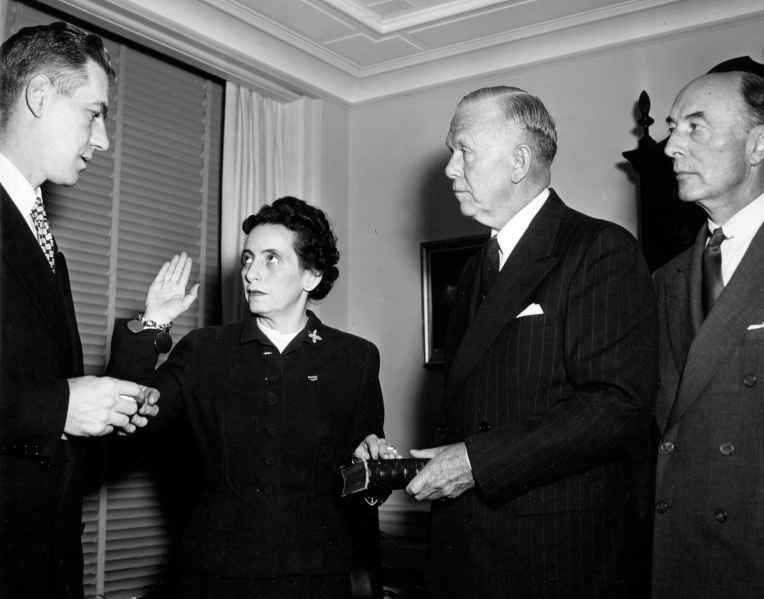 In October 1950, when Defense Secretary George C. Marshall called upon Rosenberg to return to Washington to serve as assistant secretary of defense for manpower, Anna grafted her New Deal idealism onto national security. She not only ordered the racial desegregation of the military base schools in the South—her predecessor had defied Truman’s 1948 Executive Order—but she orchestrated unprecedented numbers of American women to serve in the armed forces. “If this country is to have proper respect for its women,” Rosenberg told a reporter, evoking the social contract, “the women have to take a share of the responsibility.”[9] And they did. The thousands of women who enlisted were not merely “typewriter soldiers,” they were commencing careers as doctors and nurses, communications technicians, and intelligence analysts.
When she wasn’t visiting the troops along the front in Korea, or putting in legendarily long hours at the Pentagon, Secretary Rosenberg was successfully lobbying Congress to raise combat pay, to increase allowances for families of service members, and to ensure that no soldier spent more than one winter on the frigid and dangerous peninsula. “The boys in Korea,” reported Senator William Benton after his own inspection trip to the front line, “used to scrawl on the walls, ‘Anna was here’ . . . Was any woman ever paid greater tribute?”[10]
A fixture in newspapers and magazines from the early 1940s and for a decade afterwards, Anna Rosenberg’s contributions did not lead to a memoir or a biography, as had been the case with so many other Roosevelt advisors. As a confidante and advisor to presidents and generals, she took pride in the policies she helped foster and found that reward enough. When Eleanor Roosevelt sought to put her in touch with a biographer, Rosenberg demurred. When Henry Luce of Time-Life and other publishers offered her a deal for her memoirs, she declined. When journalist Edward R. Murrow told her, “Anna, you have quite a book to write someday,” she responded, “Ed, that’s a book that will never be written.”[11]
While some of Rosenberg’s erasure was the result of her choice not to document her life, her story has been lost for other reasons as well. As a Jewish woman, who spoke with a mix of a Bronx and a Hungarian accent, operating in spheres dominated (and chronicled) by men, she regularly faced the headwinds of sexism and antisemitism. There was also the unfortunate coincidence of her surname, which she shared with the atomic spies. The fact that she did not attend college also meant the absence of an institution that may have better kept her reputation alive. And Anna Rosenberg’s influence often came without official power, which made her impact harder to quantify.
Yet it’s important to recover Rosenberg’s story. At a time when many in the United States are challenging the idea that the federal government has a role to play in public education, in oversight, and in the workforce, we need only to look back at policies she championed to be reminded that social equality and equitable economic opportunity are the foundation of a healthy democracy. As Anna Rosenberg said in the middle of World War II, “The things that make life more than bearable, are the things that make a nation great.”[12]
Christopher C. Gorham is the author of The Confidante: The Untold Story of the Woman Who Helped Win WWII and Shape Modern America (Citadel, 2023; paperback forthcoming, February 2026), a Goodreads Choice Award finalist in History/Biography, and Matisse at War: Art and Resistance in Nazi-Occupied France (Citadel, 2025).
[1] Eric Pace, “Anna Rosenberg Hoffman Dead; Consultant and 50’s Defense Aide,” New York Times, May 10, 1983.
[2] Anna Rosenberg, “Social Security and the National Purpose,” in The Family in a World at War, ed. Sidonie Matsner Gruenberg (Harper & Brothers, 1942).
[3] Elsie Elfenbein, “An Interview with Anna M. Rosenberg,” ARH Papers, Radcliffe Institute, Cambridge, Massachusetts.
[4] Lerone Bennett, Jr., “The Day They Didn’t March,” Ebony, February 1977.
[5] David McCullough interview with Anna Rosenberg. See McCullough, Truman (Simon & Schuster, 1992), 298.
[6] Anna Rosenberg, oral history interview with Joseph Lash.
[7] Christopher C. Gorham, The Confidante: The Untold Story of the Woman Who Helped Win WWII and Shape Modern America (Citadel, 2023), chapter 12: “The Buffalo Plan.” See also, President Harry S. Truman’s citation to Anna Rosenberg honoring her with the Medal for Merit.
[8] Anna Rosenberg interview with Diane Sawyer of CBS Morning News on the centenary of FDR’s birth, January 1982. VHS tape in ARH Papers, Radcliffe Institute, Cambridge, Massachusetts.
[9] Gorham, The Confidante, chapter 20: “A Woman Is Running the Army!”
[10] Anna Rosenberg and James C. Derieux, “This I Saw in Korea,” Collier’s, Feb. 2, 1952.
[11] CBS Person to Person TV show, 1959. Guest: Anna Rosenberg; Host: Edward R. Murrow.
[12] Rosenberg, “Social Security and the National Purpose.”


