World War II: Voices of Service - TE

World War II: Voices of Service

World War II: Voices of Service explores major events of the war through the photographs, letters, and oral histories of everyday Americans. From the attack on Pearl Harbor through the GI Bill, this traveling exhibition provides an overview of important events on the battlefield and the home front.


This exhibition was funded through a grant from the Veterans Legacy Grant Program. Each panel highlights the experiences of men and women interred in National Cemeteries with a special Soldier Spotlight. The exhibition commemorates WWII Veterans and Service members through the discovery and sharing of their stories, reminding viewers that it was individual Americans from all walks of life whose service and sacrifice led to Allied victory. We invite you to use this exhibition as an example to learn more about the service of Veterans in your community.

WWII at 2025 Gala
  • Purchase: $1,950

  • Rent: $495

Logistical Information

Size: Seven freestanding retractable panels, each 33" x 81", requiring 21 running feet for display.

Purchase Information: Your institution may purchase a copy of this exhibition for permanent use for $1,950. This includes all panels, supplemental material, and carrying bags for each panel. A travel case is available as a separate purchase.

Purchase Exhibition

Gently Used Exhibitions: The Gilder Lehrman Institute is offering selected used copies of this exhibition for 75% off the purchase price! These exhibitions have previously traveled the country as part of our rental program and remain in good condition. Used exhibitions are available for purchase on a first-come, first-served basis. Photographs are available in the shop for you to review your exhibition before purchasing. Visit the shop now to claim your copy. 

Shop Used Exhibitions

Rental Information: $495 for a four-week display period

Rent Your Copy

More logistical information can be found in the World War II Exhibition Guide.

Panel One

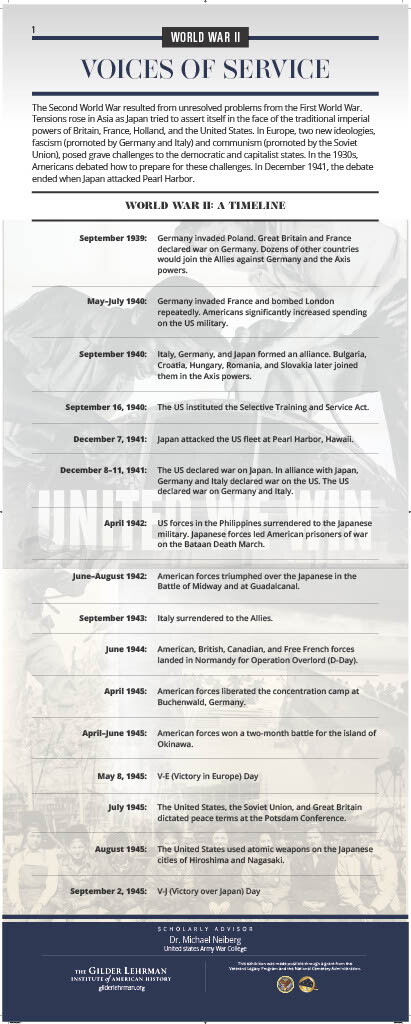
World War II: Voices of Service 

WWII_Panel 1

Panel Contents 

  • September 1939: Germany invaded Poland. Great Britain and France declared war on Germany. Dozens of other countries would join the Allies against Germany and the Axis powers.
  • May–July 1940: Germany invaded France and bombed London repeatedly. Americans significantly increased spending on the US military. 
  • September 1940: Italy, Germany, and Japan formed an alliance. Bulgaria, Croatia, Hungary, Romania, and Slovakia later joined them in the Axis powers.
  • September 16, 1940: The US instituted the Selective Training and Service Act.
  • December 7, 1941: Japan attacked the US fleet at Pearl Harbor, Hawaii
  • December 8–11, 1941: The US declared war on Japan. In alliance with Japan, Germany and Italy declared war on the US. The US declared war on Germany and Italy
  • April 1942: US forces in the Philippines surrendered to the Japanese military. Japanese forces led American prisoners of war on the Bataan Death March.
  • June–August 1942: American forces triumphed over the Japanese in the Battle of Midway and at Guadalcanal.
  • September 1943: Italy surrendered to the Allies.
  • June 1944: American, British, Canadian, and Free French forces landed in Normandy for Operation Overlord (D-Day).
  • April 1945: American forces liberated the concentration camp at Buchenwald, Germany.
  • April–June 1945: American forces won a two-month battle for the island of Okinawa
  • May 8, 1945: V-E (Victory in Europe) Day
  • July 1945: The United States, the Soviet Union, and Great Britain dictated peace terms at the Potsdam Conference.
  • August 1945: The United States used atomic weapons on the Japanese cities of Hiroshima and Nagasaki.
  • September 2, 1945: V-J (Victory over Japan) Day 

Panel Two

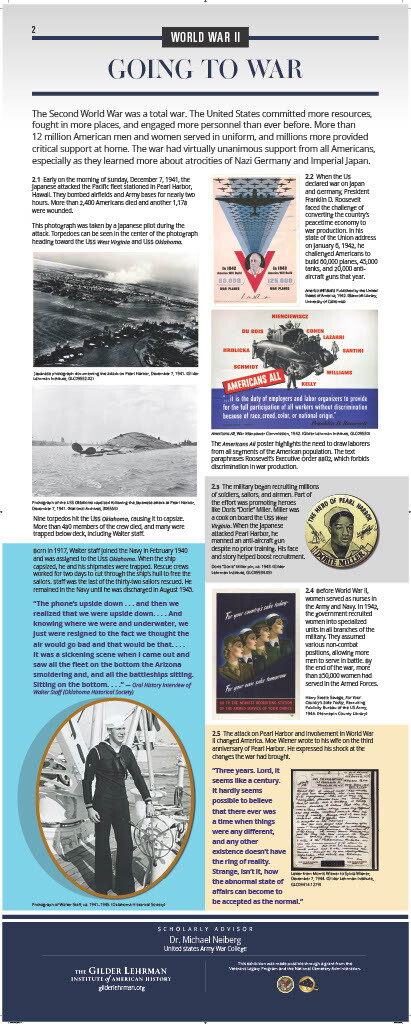
Going to War

WWII_Panel 2

Panel Contents 

  • Japanese photograph documenting the attack on Pearl Harbor, December 7, 1941. (Gilder Lehrman Institute, GLC09552.02)
  • Photograph of the USS Oklahoma capsized following the Japanese attack at Pearl Harbor, December 7, 1941. (National Archives)
  • Quote from Oral History Interview of Walter Staff (Oklahoma Historical Society)
  • America Will Build, 1942. (Bancroft Library, University of California)
  • Americans All, War Manpower Commission, 1942. (Gilder Lehrman Institute, GLC09530)
  • Doris “Dorie” Miller pin, ca. 1943. (Gilder Lehrman Institute, GLC09934.05)
  • Harry Steele Savage, For Your Country’s Sake Today, Recruiting Publicity Bureau of the US Army, 1944. (Hennepin County Library)
  • Letter from Morris Wiener to Sylvia Wiener, December 7, 1944. (Gilder Lehrman Institute, GLC09414.1279)
  • Quote from Morris Weiner 

Panel Three

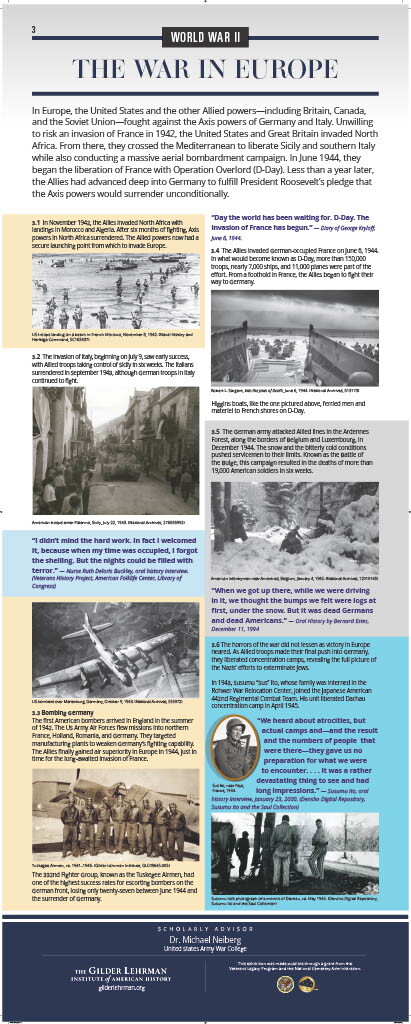
The War In Europe 

WWII_Panel 3

Panel Contents 

  • US troops landing on a beach in French Morocco, November 8, 1942. (Naval History and Heritage Command)
  • American troops enter Palermo, Sicily, July 22, 1943. (National Archives)
  • Quote from Nurse Ruth Deloris Buckley, oral history interview. (Veterans History Project, American Folklife Center, Library of Congress)
  • US bombers over Marienburg, Germany, October 9, 1943. (National Archives)
  • Tuskegee Airmen, ca. 1941–1945. (Gilder Lehrman Institute, GLC09645.005) 
  • Robert L. Sargent, “Into the Jaws of Death,” June 6, 1944. (National Archives)
  • American infantrymen near Amonines, Belgium, January 4, 1945. (National Archives)
  • Quote from Oral History by Bernard Estes, December 11, 1994.
  • Sus Ito, near Fays, France, 1944.
  • Quote from Sus Ito
  • Susumu Ito’s photograph of survivors of Dachau, ca. May 1945. (Densho Digital Repository, Susumu Ito and the Saul Collection)

Panel Four

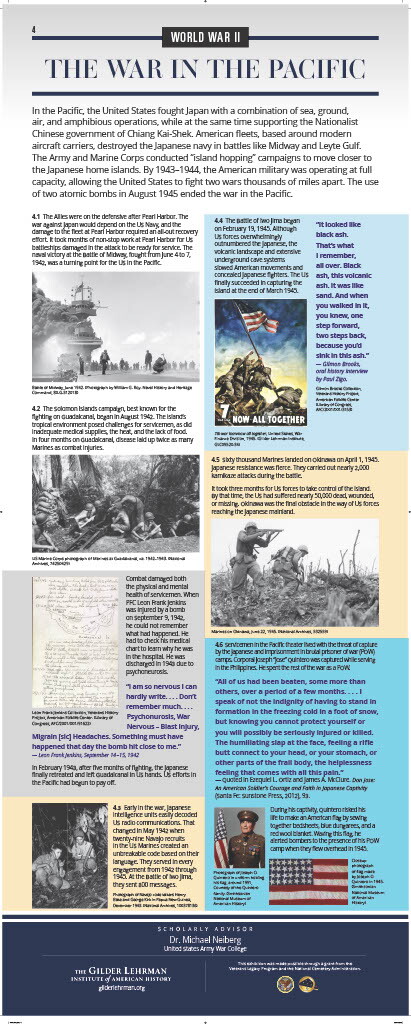
The War in the Pacific

WWII_Panel 4

Panel Contents 

  • Battle of Midway, June 1942. (Photograph by William G. Roy. Naval History and Heritage Command)
  • US Marine Corps photograph of Marines at Guadalcanal, ca. 1942–1943. (National Archives)
  • Quote from Leon Frank Jenkins
  • Photograph of Navajo code talkers Henry Bake and George Kirk in Papua New Guinea, December 1943. (National Archives)
  • Quote from Gilmon Brooks, oral history interview by Paul Zigo.
  • Gilmon Brooks Collection, Veterans History Project, American Folklife Center (Library of Congress, AFC/2001/001/3153)
  • “7th War Loan/Now All Together,” War Finance Division, 1945. (Gilder Lehrman Institute, GLC09520.34)
  • Marines on Okinawa, June 22, 1945. (National Archives)
  • Quoted in Ezequiel L. Ortiz and James A. McClure, Don Jose: An American Soldier’s Courage and Faith in Japanese Captivity (Santa Fe: Sunstone Press, 2012), 93.
  • Photograph of Joseph O. Quintero in uniform holding his flag, ca. 1991. (Courtesy of the Quintero family. Smithsonian National Museum of American History)
  • Photograph of US flag made by Joseph O. Quintero in 1945. (Smithsonian National Museum of American History) 

Panel Five

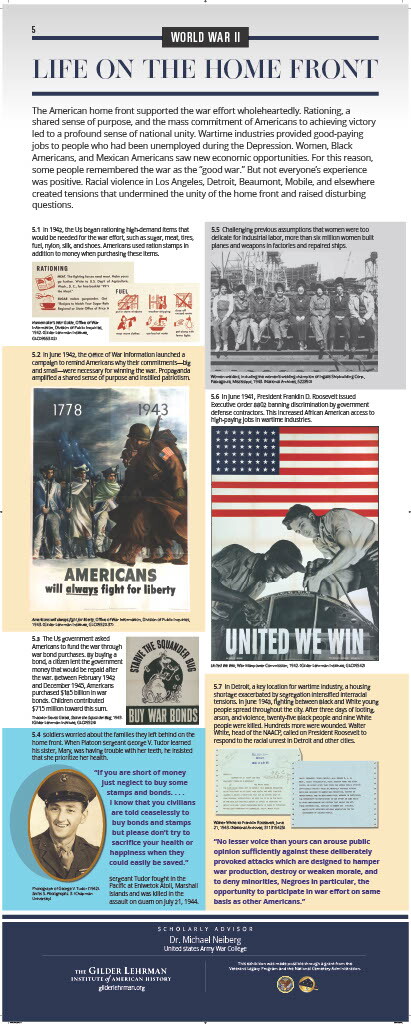
Life on the Home Front

WWII_Panel 5

Panel Contents 

  • Homemaker’s War Guide, Office of War Information, Division of Public Inquiries, 1942. (Gilder Lehrman Institute, GLC09653.02)
  • “Americans Will Always Fight for Liberty,” Office of War Information, Division of Public Inquiries, 1943. (Gilder Lehrman Institute, GLC09520.37)
  • Theodor Seuss Geisel, “Starve the Squander Bug,” 1943. (Gilder Lehrman Institute, GLC09524)
  • Quote from George V. Tudor: “If you are short of money just neglect to buy some stamps and bonds. . . . I know that you civilians are told ceaselessly to buy bonds and stamps but please don’t try to sacrifice your health or happiness when they could easily be saved.”
  • Photograph of George V. Tudor, 1942. (Chapman University)
  • Women welders, including the women’s welding champion of Ingalls Shipbuilding Corp., Pascagoula, Mississippi, 1943. (National Archives) 
  • “United We Win,” War Manpower Commission, 1942. (Gilder Lehrman Institute, GLC09542) 
  • Walter White to Franklin Roosevelt, June 21, 1943. (National Archives)
  • Quote from Walter White 

Panel Six

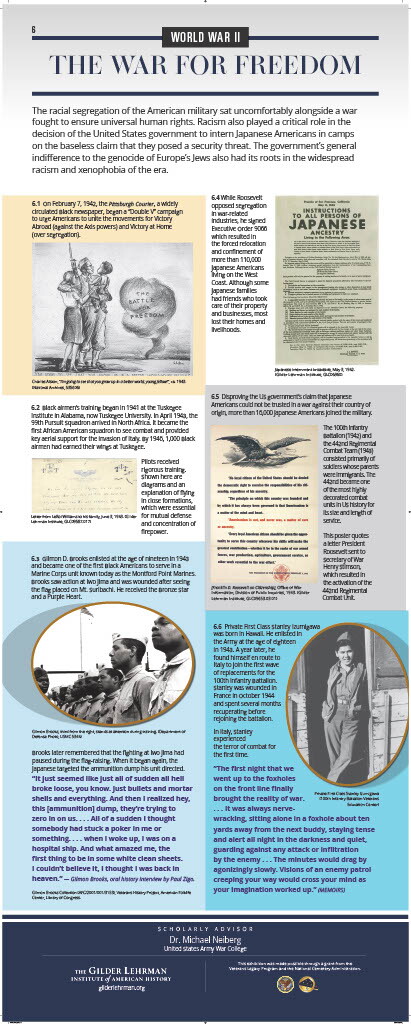
The War for Freedom 

WWII_Panel 6

Panel Contents 

  • Charles Alston, “I’m going to see that you grow up in a better world, young fellow!,” ca. 1943. (National Archives) 
  • Letter from LeRoi Williams to his family, June 3, 1943. (Gilder Lehrman Institute, GLC09587.017)
  • Gilmon Brooks, third from the right, stands at attention during training. (Department of Defense Photo, USMC 5344)
  • Quote from Gilmon Brooks Collection (AFC/2001/001/3153) (Veterans History Project, American Folklife Center, Library of Congress)
  • Japanese internment broadside, May 3, 1942. (Gilder Lehrman Institute, GLC06360)
  • [Franklin D. Roosevelt on Citizenship], Office of War Information, Division of Public Inquiries, 1943. (Gilder Lehrman Institute, GLC09653.03.01)
  • Private First Class Stanley Izumigawa (100th Infantry Battalion Veterans Education Center)
  • Quote from Private First Class Stanley Izumigawa 

Panel Seven

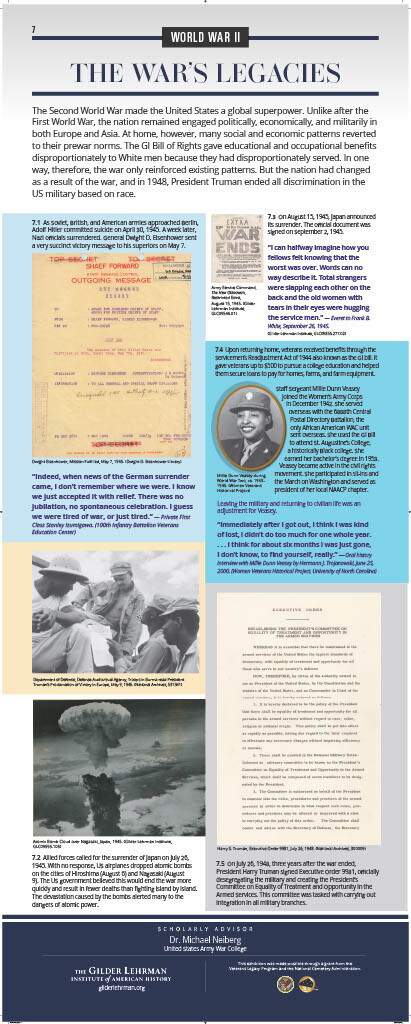
The War’s Legacies

WWII_Panel 7

Panel Contents 

  • Dwight Eisenhower, Mission Fulfilled telegram, May 7, 1945. (Dwight D. Eisenhower Library)
  • Quote from Private First Class Stanley Izumigawa. (100th Infantry Battalion Veterans Education Center)
  • Troops in Burma read President Truman’s Proclamation of Victory in Europe, May 9, 1945. (National Archives)
  • Atomic Bomb Cloud over Nagasaki, Japan, 1945. (Gilder Lehrman Institute, GLC09595.105) 
  • Army Service Command, The New Okinawan, Restricted Extra, August 15, 1945. (Gilder Lehrman Institute, GLC09546.01)
  • Quote from Everet to Frank B. White, September 26, 1945. (Gilder Lehrman Institute, GLC09855.277.02)
  • Millie Dunn Veasey during World War Two, ca. 1943– 1945. (Women Veterans Historical Project) 
  • Quote from Oral history interview with Millie Dunn Veasey by Hermann J. Trojanowski, June 25, 2000. (Women Veterans Historical Project, University of North Carolina)
  • Harry S. Truman, Executive Order 9981, July 26, 1948. (National Archives) 

Exhibition Resources

These resources have been curated to offer documents, videos, reading suggestions, and more for the World War II: Voices of Service exhibition.

Selected Essays

History Now

History Now, the online journal of the Gilder Lehrman Institute, offers the latest in historical scholarship to K−12 teachers, students, and general readers. Each issue is organized around a major topic in American history and features short, informative essays by leading scholars. Click here for even more essays related to World War II.

Full Issues

Essays


Books

Books for Further Reading

Each of the following books has been featured in an episode of the Gilder Lehrman Institute’s Book Breaks program. The links below lead to the Book Breaks interview with the authors. Click here for even more Book Breaks related to World War II.

Online Courses

Online Courses 

  • World War II (Michael Neiberg, US Army War College): This course aims to put context and nuance into the traditional American views of the Second World War. Although keeping the American experience at the center, it will always view that experience through a global lens.
  • The World at War (Michael Neiberg, US Army War College): This course examines the role of the two world wars in shaping modern American history. (Only available as a Self-Paced Course)

Click here to explore the full catalog of Self-Paced Courses and History U Courses.

Lesson Plans

Frequently Asked Questions

If you need more information, please fill out this traveling exhibitions inquiry form. We strive to respond to inquiries within one business day. 

Setup Guide

General Questions

Do I need to pay sales tax?
State sales tax laws vary. You may be liable for sales taxes. The Gilder Lehrman Institute will contact you about your potential sales tax obligations.

How can I pay?
We accept credit cards, checks, and purchase orders, but we do not currently accept bank transfers.

Do you offer any discounts or grants?
Unfortunately, we are unable to offer any discounts or grants at this time. We recommend DonorsChoose for schools that need financial assistance to rent or purchase an exhibition.

How do you ship the exhibitions?
Exhibitions are shipped in wheeled cases measuring 15 x 15 x 40 inches and weighing approximately 90 pounds. FedEx handles all shipping. Once your exhibition has shipped, you will receive a tracking number.

How do I set up the exhibition?
We include detailed setup instructions with each rental. Please note that different exhibitions have slightly different setup instructions, so make sure you refer to the correct type of exhibition.

What happens if something breaks after I receive my exhibition?
We are always here to help you troubleshoot or order new parts. The venue will bear the costs of replacement parts due to venue error or excessive wear and tear.

Purchase

What materials are included in my exhibition purchase?
With your purchase, we will order a brand-new exhibition to send to you. Each panel comes in its own zipped sleeve for storage and transport. You will also receive all the supplementary materials typically included with a rental, including the Exhibition Guide and setup instructions.

Does my purchased exhibition come with the travel/storage case?
The travel/storage case is a separate purchase. You can add a case for your exhibition for an additional $500 on the same menu where you bought the exhibition. All exhibitions can fit into one case, except for Freedom: A History of the US, which requires two.

Is shipping included in the purchase price?
Yes!

Can I purchase a “used” exhibition instead of a new one for a lower price?
Occasionally, a limited number of gently used exhibitions are available for purchase at a discounted price. For the current selection of gently used exhibitions, visit the shop. Exhibitions are available on a first-come, first-served basis and are sold as-is. 

How long will it take to receive my exhibition?
Once we receive payment, please allow 2 weeks to print and ship your new exhibition. Exhibition orders are not sent for printing until we receive payment in full.

Rental

How long is the rental period?
4 weeks. Please let us know if you would like a longer booking period, and we will do our best to accommodate you! However, we cannot offer discounts for shortened booking periods.

How far in advance should I book my rental?
It is recommended to book 2–3 months in advance of your desired rental date, but we can accept bookings up to a year in advance. Please note that we do not ship exhibitions until payment is received in full, so please keep this in mind when booking your exhibition.

What is included in my rental fee?
The rental cost is a flat fee that covers shipping, the exhibition, and supplemental materials. Extra charges will only occur if a venue damages an exhibition.

Can I bring the exhibition to multiple venues during my rental period?
Exhibitions are limited to the location booked in the contract. While you’re free to relocate the exhibition to different buildings or rooms within your contracted location, we do not permit any other circulation of the exhibition. If you need to feature an exhibition at various locations, we recommend purchasing it rather than renting it.

Can I reschedule my rental?
If your new rental dates are available, we will happily reschedule your rental, provided the exhibition has not already shipped to you.

How do I ship the exhibition back to you?
We’ll send you a FedEx label up to 10 days before the end of your display period and set up a pickup appointment for your exhibition return. Please remove any existing labels from the case before attaching the new one, and notify our team if there are any special instructions for FedEx.